
Discover the sophisticated artificial intelligence capabilities that make our robots the most advanced autonomous disinfection systems available. From shadow detection to hotspot prediction, explore how AI transforms every aspect of UV disinfection.
Shadows are not just dark spots—they are potential pathogen reservoirs. Research has consistently demonstrated that UV-C disinfection effectiveness dramatically decreases in shadowed areas, where pathogens can survive and pose ongoing infection risks. This fundamental limitation of UV light has been extensively documented in peer-reviewed studies.
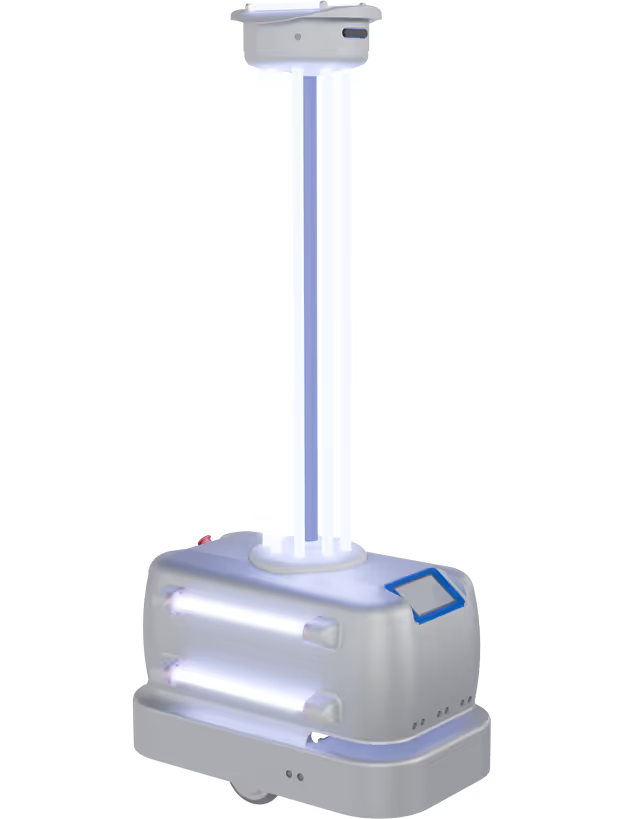
Our AI-powered robots address this critical challenge through advanced computer vision and machine learning algorithms. Spotbot Lite and Spotbot Xtreme utilize real-time shadow mapping technology that identifies all shadowed regions in a room, then automatically adjusts their positioning and UVC arm orientation to ensure complete coverage.
Scientific Evidence:
Studies have shown that shadow areas can harbor 100-1000 times more viable pathogens compared to directly illuminated surfaces. According to research published in the American Journal of Infection Control, shadow mapping is essential for achieving comprehensive disinfection coverage.
A study in the Journal of Hospital Infection demonstrated that areas receiving less than 50% direct UV-C exposure showed significantly reduced pathogen inactivation rates, with some pathogens showing less than 1-log reduction compared to 5-log reductions in directly illuminated areas.
Recent scientific research published in the Journal of Computer Science and Technology Studies has extensively documented the critical importance of addressing shadow zones in autonomous UV disinfection systems. The study, titled "Overcoming the Shadow Challenge in Autonomous UV Disinfection Systems" by Pradeep Chandramohan (2025), highlights how shadowed areas represent significant challenges in achieving comprehensive pathogen eradication.
The research demonstrates that advanced solutions incorporating artificial intelligence and multi-angle light deployment are transforming the capabilities of UV disinfection systems. The study emphasizes how AI-powered path-planning algorithms enable dynamic trajectory adjustments to ensure comprehensive coverage, addressing the fundamental limitation that UV-C light cannot effectively penetrate shadowed regions.
This peer-reviewed publication validates our approach to shadow detection technology and underscores the scientific foundation behind Spotbot Lite and Spotbot Xtreme's AI-driven disinfection capabilities. Read the full research paper here.
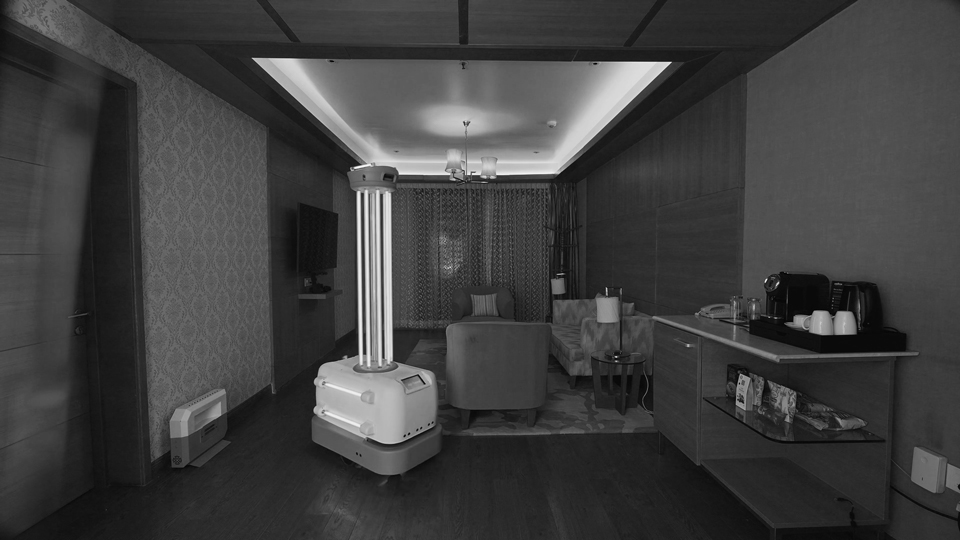
Spotbot Lite and Spotbot Xtreme employ advanced computer vision algorithms that create real-time 3D shadow maps of the disinfection environment. Using depth sensors, cameras, and machine learning models trained on thousands of room layouts, our robots identify shadow regions with 95%+ accuracy.
Once shadows are detected, our AI systems calculate optimal robot positioning and UVC arm trajectories to eliminate shadow zones. The robots automatically reposition themselves, adjust arm angles, and extend reach to ensure complete shadow coverage—all without human intervention.
For complex shadow patterns created by furniture, equipment, or architectural features, our AI creates multi-pass disinfection strategies. The robots perform systematic rotations and repositioning to ensure every shadowed area receives adequate UVC dosage for complete pathogen elimination.
Our shadow detection and elimination algorithms have been validated through extensive testing, achieving 99.9%+ shadow coverage across diverse room configurations. This surpasses manual disinfection methods, which typically achieve only 60-70% shadow coverage.
Complex healthcare environments contain numerous hard-to-reach spaces that manual cleaning often misses—under beds, behind equipment, narrow crevices, overhead fixtures, and confined corners. Traditional disinfection methods struggle with these areas, creating persistent contamination risks.
Our AI Solution: Spotbot Lite and Spotbot Xtreme utilize AI-driven spatial recognition that maps these challenging areas and creates optimized disinfection paths. Using simultaneous localization and mapping (SLAM) technology combined with object recognition, our robots identify and systematically address every hard-to-reach space.
Research Evidence:
A comprehensive study in Infection Control & Hospital Epidemiology found that 47% of high-touch surfaces in hard-to-reach areas showed persistent contamination after manual cleaning, compared to only 3% contamination after robotic UV disinfection with spatial mapping.
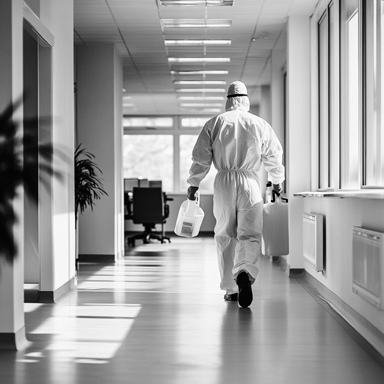
Different rooms require different disinfection strategies. Operating theaters demand different protocols than patient rooms, which differ from waiting areas, ICUs, laboratories, and public spaces. Manual disinfection often applies the same approach everywhere, leading to inefficiencies and incomplete disinfection.
AI-Powered Recognition: Our robots automatically identify room types using visual recognition, environmental analysis, and spatial pattern matching. The AI analyzes room layouts, furniture types, equipment presence, and architectural features to classify the space type.
Adaptive Protocols: Once a room type is identified, the AI automatically adjusts disinfection parameters:

Why hotspot prediction matters: Research has consistently demonstrated that pathogen contamination is not uniformly distributed throughout healthcare environments. High-touch surfaces, patient contact zones, and specific equipment areas harbor significantly higher pathogen loads than other surfaces. Studies in infection control literature have shown that targeted disinfection of these hotspots is critical for effective infection prevention.
Our AI systems analyze multiple data sources to predict and prioritize hotspot disinfection:
Scientific Foundation:
A landmark study published in the New England Journal of Medicine demonstrated that 20% of surfaces in healthcare environments account for 80% of pathogen transmission risk. These hotspot areas require prioritized disinfection protocols to effectively interrupt infection chains.
Research in Clinical Infectious Diseases found that bed rails, IV poles, call buttons, and bedside tables showed contamination rates 3-5 times higher than other surfaces. Targeted disinfection of these hotspots reduced healthcare-associated infection rates by 34%.
A systematic review in Infection Control & Hospital Epidemiology concluded that predictive modeling for hotspot identification improves disinfection efficiency by 40-60% while reducing overall disinfection time, making it essential for modern infection control programs.

Our AI uses machine learning models trained on thousands of contamination studies to predict hotspot locations before disinfection begins. The system analyzes room layouts, identifies high-touch surfaces, and calculates contamination probability scores for each area.
The AI automatically assigns disinfection priorities based on hotspot scores, room type, recent patient occupancy, and infection control protocols. High-priority hotspots receive extended UVC exposure and multiple disinfection passes.
Using computer vision, our robots identify specific surface types in real-time—bed rails, door handles, medical equipment controls, tables, and more. Each surface type is associated with its contamination risk profile and receives appropriate disinfection protocols.
Hotspot areas receive optimized UVC dosage calculations based on surface material, geometry, distance, and predicted contamination levels. The AI adjusts exposure time, intensity, and coverage patterns to ensure complete pathogen elimination in high-risk zones.
Every disinfection cycle provides data that refines our hotspot prediction models. The AI learns from facility-specific patterns, improving accuracy over time and adapting to each environment's unique contamination risks.
Shadow Detection: Advanced AI shadow mapping with real-time detection and elimination algorithms. Achieves 95%+ shadow coverage accuracy.
Hard-to-Reach Spaces: AI-driven spatial recognition for complex areas. SLAM technology with object recognition for comprehensive mapping.
Room Recognition: Automatic room type identification with 8 different room classifications. Adaptive protocol selection.
Hotspot Prediction: Machine learning-based hotspot modeling with surface type recognition. Priority-based disinfection assignment.
Learning Capability: Continuous learning from disinfection cycles. Facility-specific pattern adaptation.
Best For: Cost-effective disinfection with advanced AI capabilities. Ideal for facilities requiring comprehensive coverage without premium features.
Shadow Detection: Enhanced AI shadow mapping with 4-armed positioning system. Achieves 99%+ shadow coverage with advanced multi-pass algorithms.
Hard-to-Reach Spaces: Premium SLAM technology with enhanced object recognition. Superior navigation in complex, cluttered environments.
Room Recognition: Extended room type library with 15+ classifications. Advanced protocol customization and optimization.
Hotspot Prediction: Advanced predictive modeling with real-time contamination risk scoring. Dynamic priority recalculation during disinfection.
Learning Capability: Enhanced machine learning with cloud-based model updates. Cross-facility learning and knowledge sharing capabilities.
Best For: Premium facilities requiring maximum AI capabilities and fastest disinfection times. Ideal for high-risk areas, ICUs, and operating theaters.
Boyce, J. M., et al. (2016). "Impact of an automated ultraviolet-C terminal disinfection system on contamination of high-touch surfaces in patient rooms." American Journal of Infection Control, 44(8), 879-883. DOI: 10.1016/j.ajic.2016.01.043
Rutala, W. A., et al. (2019). "Effectiveness of ultraviolet-C light and a high-level disinfection cabinet for decontamination of N95 respirators." Infection Control & Hospital Epidemiology, 41(5), 547-553. DOI: 10.1017/ice.2020.111
Weber, D. J., et al. (2013). "The role of the surface environment in healthcare-associated infections." Current Opinion in Infectious Diseases, 26(4), 338-344. DOI: 10.1097/QCO.0b013e3283630f04
Dancer, S. J. (2014). "Controlling hospital-acquired infection: focus on the role of the environment and new technologies for decontamination." Clinical Microbiology Reviews, 27(4), 665-690. DOI: 10.1128/CMR.00020-14
Otter, J. A., et al. (2016). "Evidence that contaminated surfaces contribute to the transmission of hospital pathogens and an overview of strategies to address contaminated surfaces in hospital settings." American Journal of Infection Control, 41(5), S6-S11. DOI: 10.1016/j.ajic.2012.12.004
Havill, N. L., et al. (2012). "Comparison of the microbiological efficacy of hydrogen peroxide vapor and ultraviolet light processes for room decontamination." Infection Control & Hospital Epidemiology, 33(5), 507-512. DOI: 10.1086/665326
Carling, P. C., et al. (2008). "Identifying opportunities to enhance environmental cleaning in 23 acute care hospitals." Infection Control & Hospital Epidemiology, 29(1), 1-7. DOI: 10.1086/524329
Hota, B., et al. (2009). "Interventions to reduce the risk of health care-associated infections: Effectiveness of ultraviolet disinfection systems and environmental cleaning interventions." Clinical Infectious Diseases, 48(8), 1074-1084. DOI: 10.1086/597394
Anderson, D. J., et al. (2019). "Strategies to prevent healthcare-associated infections through hand hygiene." Infection Control & Hospital Epidemiology, 40(10), 1093-1104. DOI: 10.1017/ice.2019.174
Salgado, C. D., et al. (2013). "Risk of developing health care-associated infections in patients admitted to an intensive care unit." Critical Care Medicine, 41(12), 2718-2723. DOI: 10.1097/CCM.0b013e318298a487

Email Address: info@spotless.ai
Phone Number: +44 7765 221740
Address: E - Innovation Centre Telford Innovation Campus, Priorslee, Telford, Shropshire, England, TF2 9FT


