
UV-C disinfection limitations are usually the last thing vendors put on the brochure. Infection-control officers and hospital quality heads who have already seen overclaiming deserve the opposite: limitations first, then the genuine value.
This honest guide states what 254nm UV-C can do well, what it cannot do, and the clean → disinfect → verify hierarchy that keeps environmental programmes defensible. If a supplier will not list these boundaries in writing, treat every other claim with caution.
For the underlying wavelength physics, see how UV-C disinfection works. For how to read log and dose claims, see UV-C log reduction explained.
UV-C Disinfection Limitations Buyers Should Demand Up Front
The UV-C market has an overclaiming problem. Buyers are told devices “sterilise rooms,†“replace cleaning,†or “cover everythingâ€â€”phrases that collapse under assessor questions and under the physics of light.
Why this post exists is simple: sceptical quality heads convert faster when a vendor lists its own boundaries without being forced. Honesty is not a soft skill here; it is the filter that separates usable technology from brochure theatre.
SpotlessAI would rather lose a sale that required fantasy than win one that later fails an infection-control interview. That posture starts with naming UV-C disinfection limitations clearly.
What UV-C Does Well
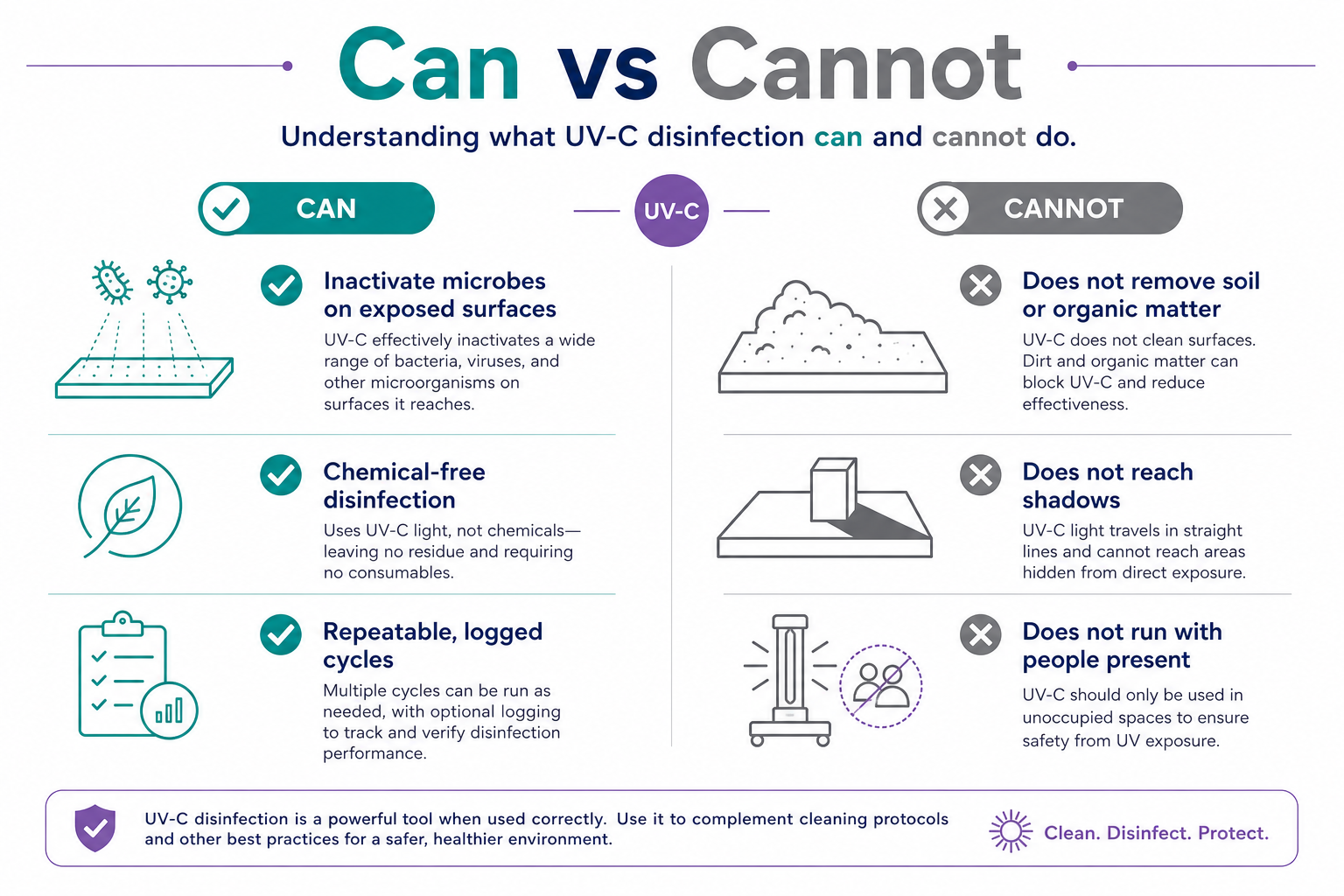
Used correctly, germicidal UV-C is a strong adjunct layer. On exposed surfaces—and in air within the treated enclosed room—it can rapidly inactivate vegetative bacteria and many enveloped viruses when dose and geometry are adequate.
It is chemical-free at the point of use: no disinfectant residue left on finishes, no aeration step of the kind chemical fogging often requires. Cycles can be repeated the same way each time and logged with timestamps, room identity, and completion status.
That combination—speed, repeatability, and documentation—is why hospitals add UV-C after terminal cleaning rather than instead of it. Authoritative UVGI overviews such as CDC/NIOSH guidance treat application geometry and exposure control as first-class concerns for the same reason.
What UV-C Cannot Do
UV-C does not remove soil, dust, or organic debris. Photons inactivate exposed microorganisms; they do not wipe a surface clean. Asking “does UV light clean surfaces?†has a short answer: no.
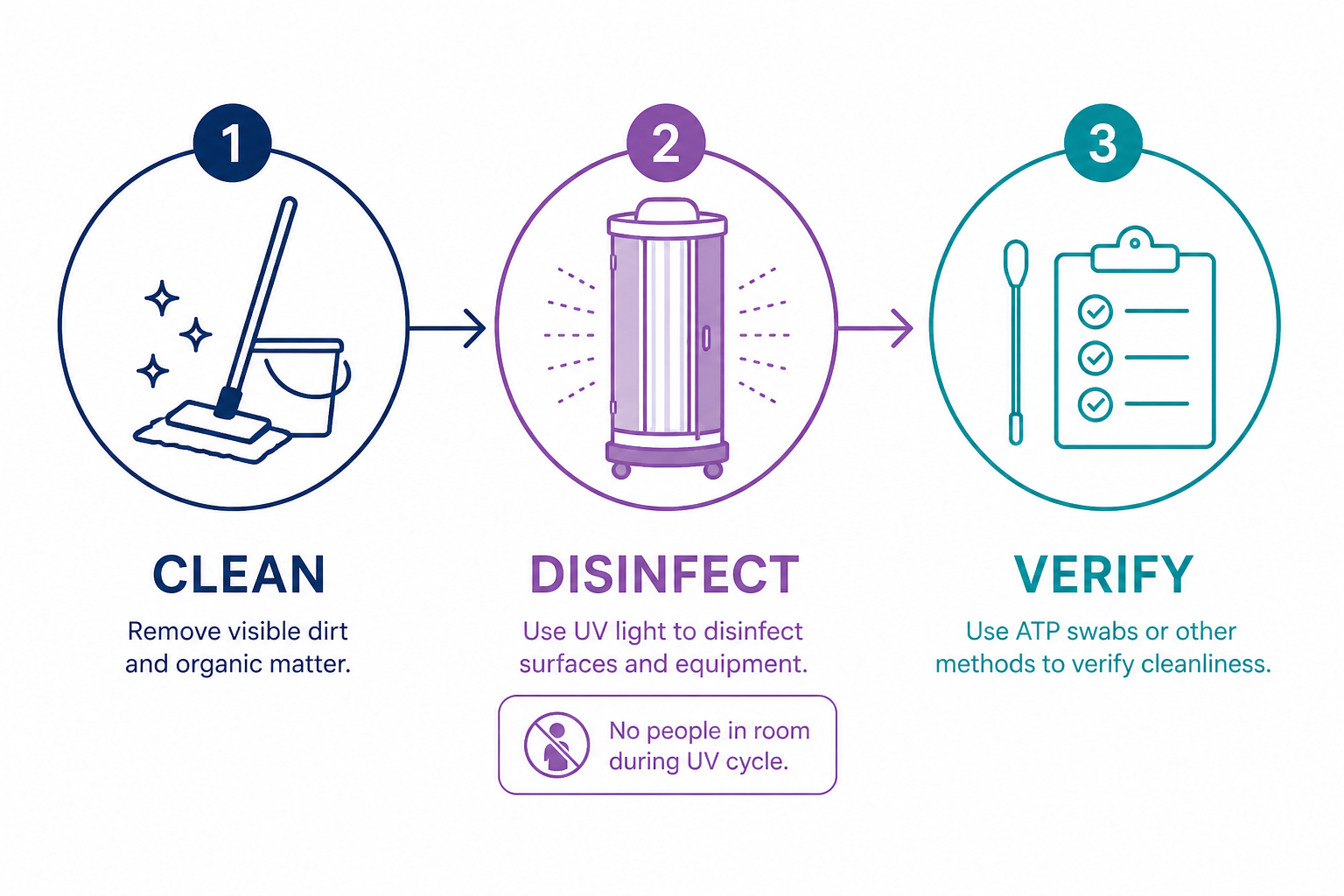
It does not reliably reach shadowed surfaces—undersides of beds, far sides of equipment, drawer interiors—unless mitigated by multi-position cycles, room prep, and manual follow-up. It does not penetrate fabrics meaningfully. It does not substitute for terminal manual cleaning. And it must not run with people present: the safe unit is an enclosed, vacated room with the door closed. A curtain is not a barrier.
Any vendor story that needs people “keeping their distance†inside the treated space is describing an unsafe protocol, not a clever deployment tip.
Does UV Light Clean Surfaces? No—Use Clean → Disinfect → Verify
The correct hierarchy is short enough to put on a ward poster:
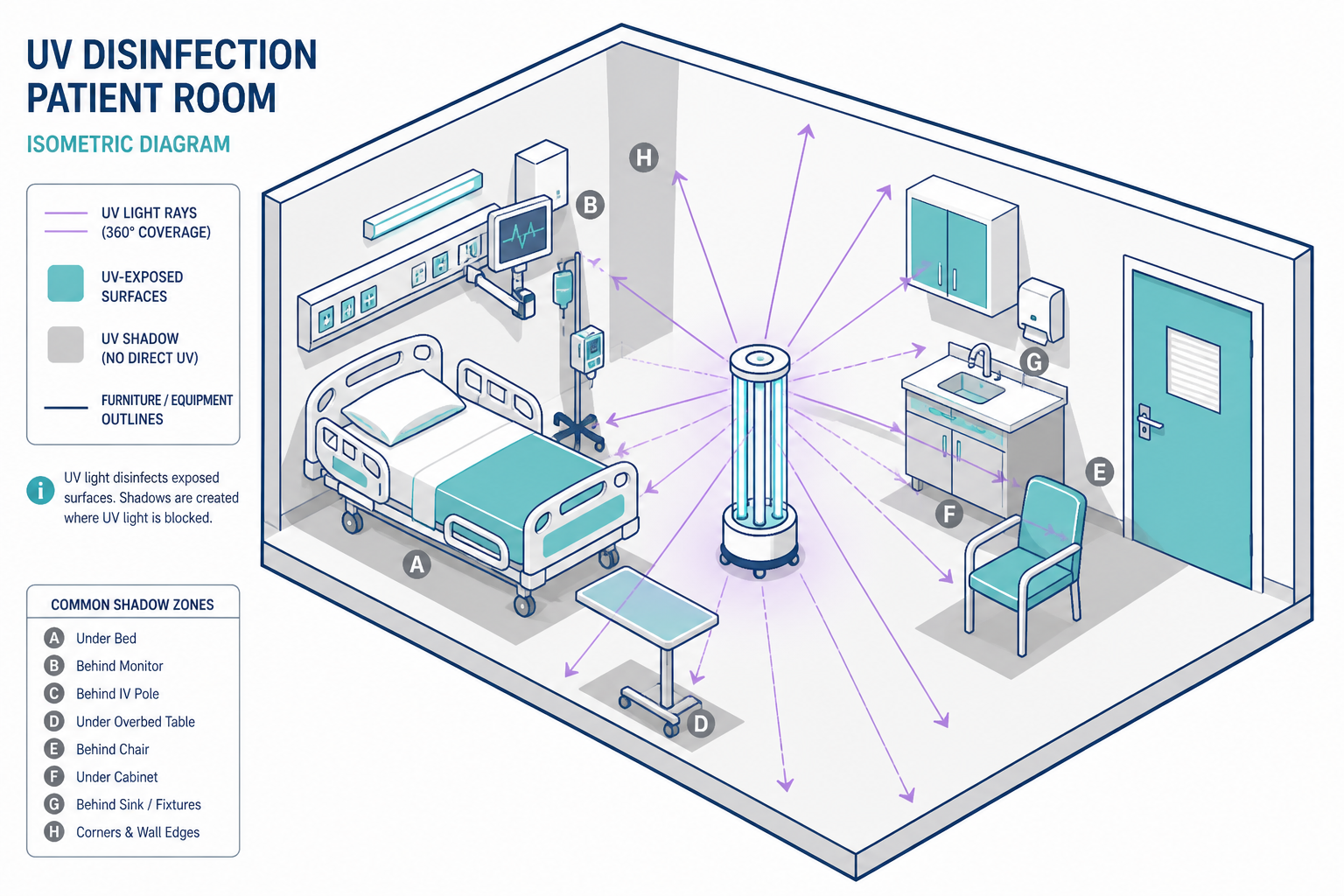
- Clean first — remove soil so microbes are not shielded.
- Disinfect second — run UV-C as the adjunct layer on exposed surfaces in a vacated enclosed room.
- Verify third — use swabs, ATP, or fluorescent-marker programmes per facility policy.
Skip the first step and even a perfect UV cycle underdelivers. Skip the third and you are assuming rather than knowing. SpotlessAI’s field figure—99.99% bacterial elimination across 1,000+ swab points at a 300-bed hospital—is positioned explicitly as post-manual-clean adjunct performance, not as a licence to skip wiping.
Where UV-C Genuinely Changes Outcomes
Manual cleaning remains essential—and still misses a measurable share of high-touch surfaces under time pressure. UV-C’s honest value is the safety-net role: a no-touch terminal step that treats every exposed surface in the optical field the same way, every cycle, after cleaning.
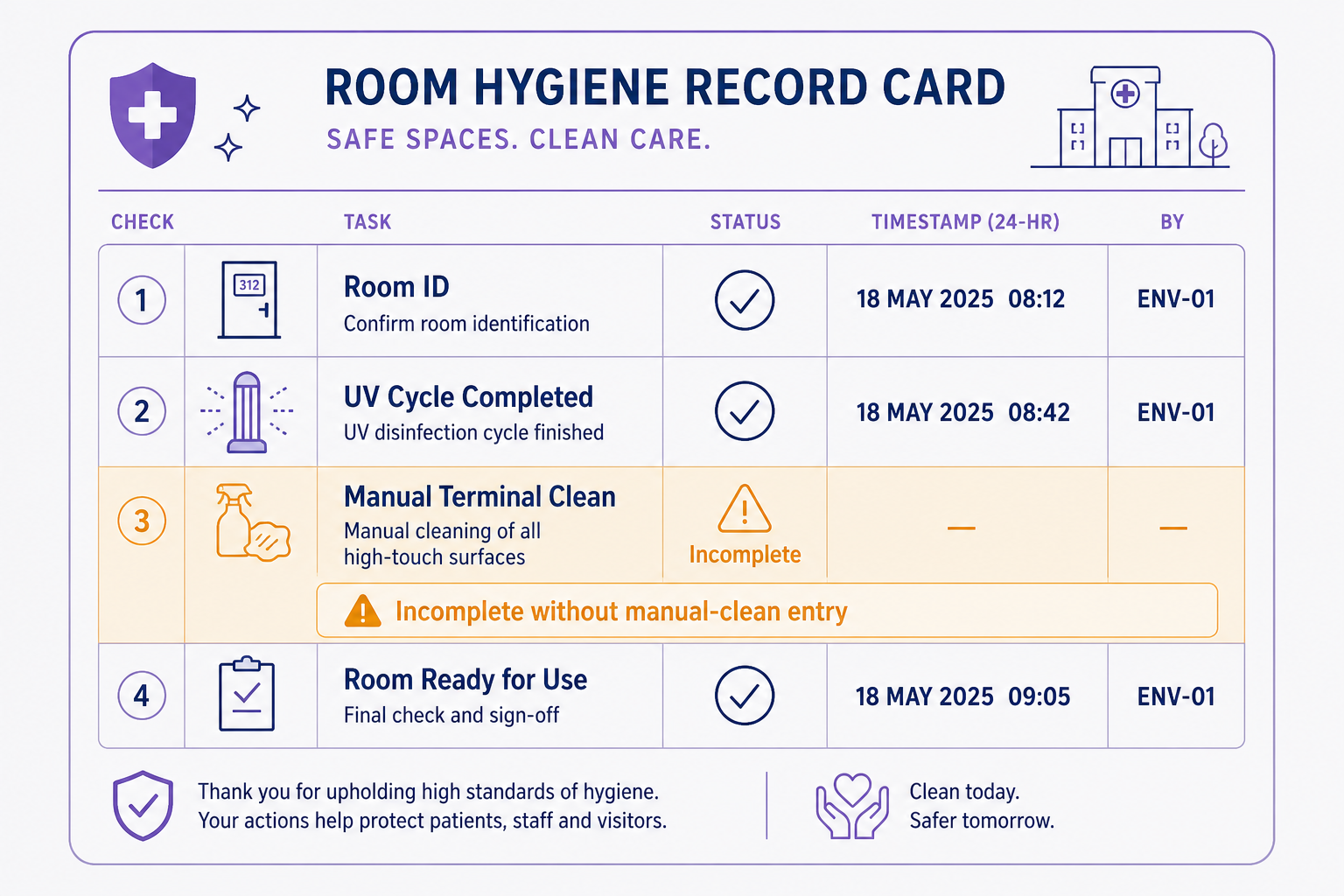
It also standardises documentation. Machine-generated cycle records—room, time, completion—support infection-prevention files when hospitals govern review and archive discipline. That is process reliability, not magic coverage of every square centimetre.
For how intelligent UV-C sits in broader hospital programmes, see 10 Ways Intelligent UVC Disinfection Is Transforming Modern Hospitals. Keep expectations tied to adjunct performance, not replacement of EVS skill.
When a room record shows a UV cycle but no manual-clean entry, the file is incomplete—even if the robot report looks pristine. Assessors and surveyors read the chain, not the isolated tick.
The honest caveat
Even a perfect UV-C cycle over a soiled surface underdelivers—soil shields microbes from the light. A room hygiene record without a manual-clean entry is incomplete, no matter how detailed the UV cycle report.
Key Takeaways
- Credible vendors list UV-C disinfection limitations before they list features.
- UV-C inactivates microbes on exposed surfaces; it does not clean soil or dust.
- Shadows, fabrics, and occupied spaces are hard stops—not minor footnotes.
- Use clean → disinfect → verify; never skip manual cleaning for a UV cycle.
- UV-C’s real value is a repeatable, loggable safety net after cleaning—not total coverage fantasy.
Frequently Asked Questions
Does UV light clean surfaces?
No. UV-C does not remove dirt, dust, or organic debris. Manual cleaning removes soil; UV-C then inactivates microorganisms on exposed surfaces as an adjunct.
Can UV-C replace terminal manual cleaning?
No. UV-C is an adjunct after terminal cleaning in vacated rooms. A cycle run over a soiled surface will underdeliver because soil shields microbes.
Does UV-C cover every surface in a patient room?
Not in a single emitter position in a furnished room. Shadowed zones need multi-position strategies, room prep, and targeted manual follow-up. Claiming 100% coverage of a furnished room is a reason to distrust the rest of the pitch.
Can we run UV-C while staff stay in the room at a distance?
No. 254nm room disinfection is for enclosed, unoccupied spaces with the door closed. Curtains are not barriers. Follow hospital safety procedures and device guidance.
How does Spotbot respect these limitations?
Spotbot Lite by SpotlessAI is designed for unoccupied rooms after routine manual cleaning, with cycle records that support documentation. Talk to our team if you want to walk through how those boundaries are built into deployment practice.
Conclusion
What UV-C can and cannot do is not a branding exercise. It is the difference between a programme infection-control leaders will defend and a purchase they will quietly regret.
Keep the hierarchy: clean first, disinfect with UV-C in an empty enclosed room, verify according to policy. Keep the limitations visible: no soil removal, no shadow miracles, no occupied-room cycles.
If that framing matches how your facility thinks, talk to our team. We would rather start from shared honesty than from a slide that overpromises.