
UV-C pharmaceutical clean room conversations go wrong when vendors invent a Grade A role that Annex 1 never gave them. A contamination control strategy (CCS) under EU GMP Annex 1 (2022) demands that every control be justified, assessed, and monitored. Adjunct physical disinfection can sit in that strategy—modestly, in support geography, with paperwork—not as a substitute for HEPA, pressure cascades, or qualified disinfectants.
This post uses Annex 1 vocabulary deliberately. For dose language, see UV-C log reduction explained. For verification humility outside GMP, see ATP testing hospital cleaning. For measured lamp output discipline, see UV-C lamp lifespan degradation. For vacate-before-cycle safety, see UV-C safety occupied room.
Contamination Control Strategy Disinfection Inside the CCS Frame
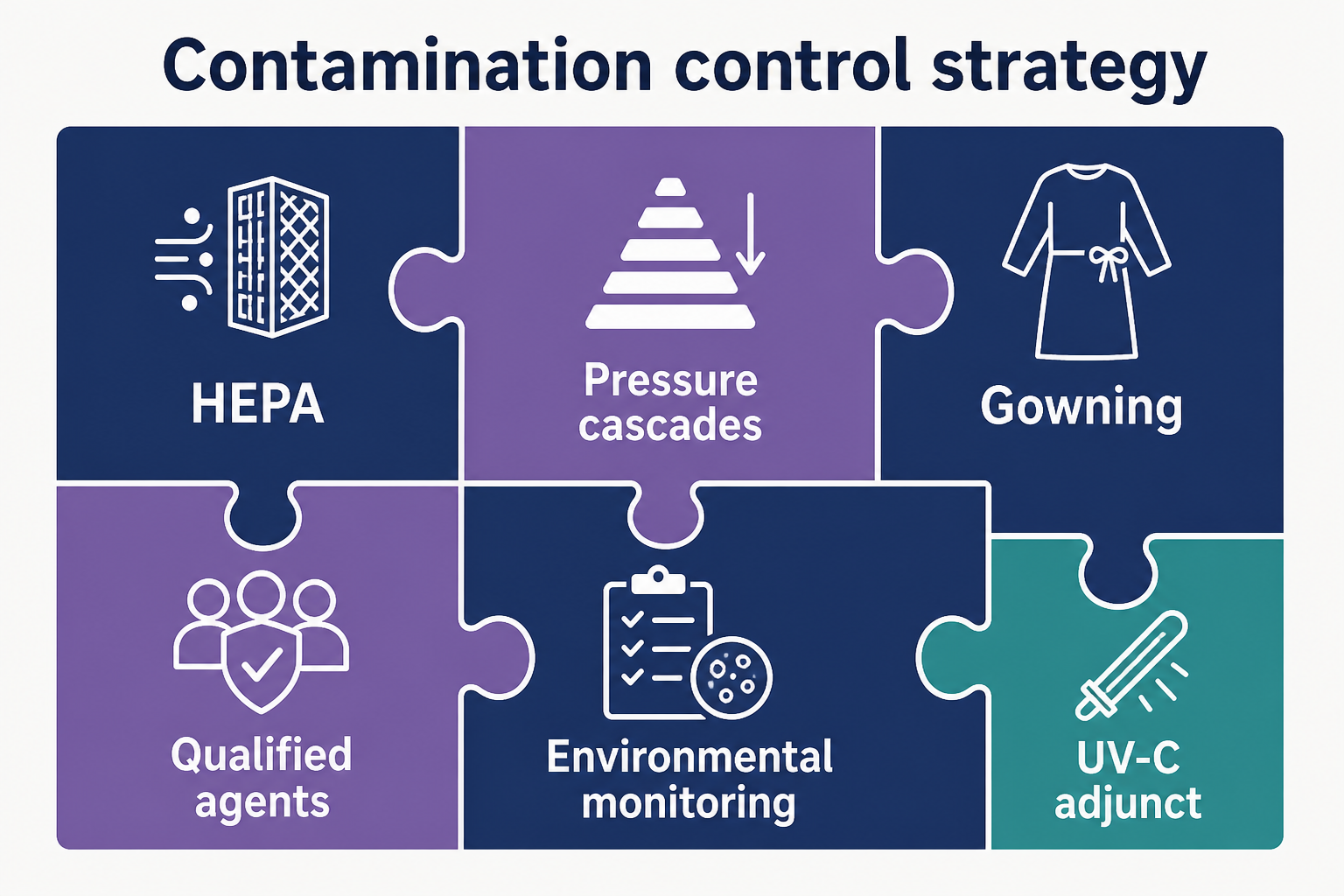
Annex 1’s CCS shift asks facilities to treat contamination control as a holistic system—not a stack of disconnected SOPs. Air, surfaces, people, materials, and monitoring interact. Each control needs rationale, assessment, and ongoing review. Official text lives with the European Commission / EMA Annex 1 revision for sterile medicinal products (EU GMP Annex 1, 2022).
Contamination control strategy disinfection therefore means placing any adjunct—including UV-C—inside that justified system. UV-C does not clean soil or debris; it is a physical adjunct after cleaning with qualified disinfectants where those agents apply. Without a CCS slot, a glowing lamp is just equipment theatre.
QA readers will notice when a brochure skips that frame. Precision is the differentiator: state the control, the geography, the environmental monitoring (EM) proof, and the residual risk you are not pretending to erase. Holistic does not mean “add every technology”; it means every retained control earns its place under change control and review.
UV-C Pharmaceutical Clean Room Grade Geography
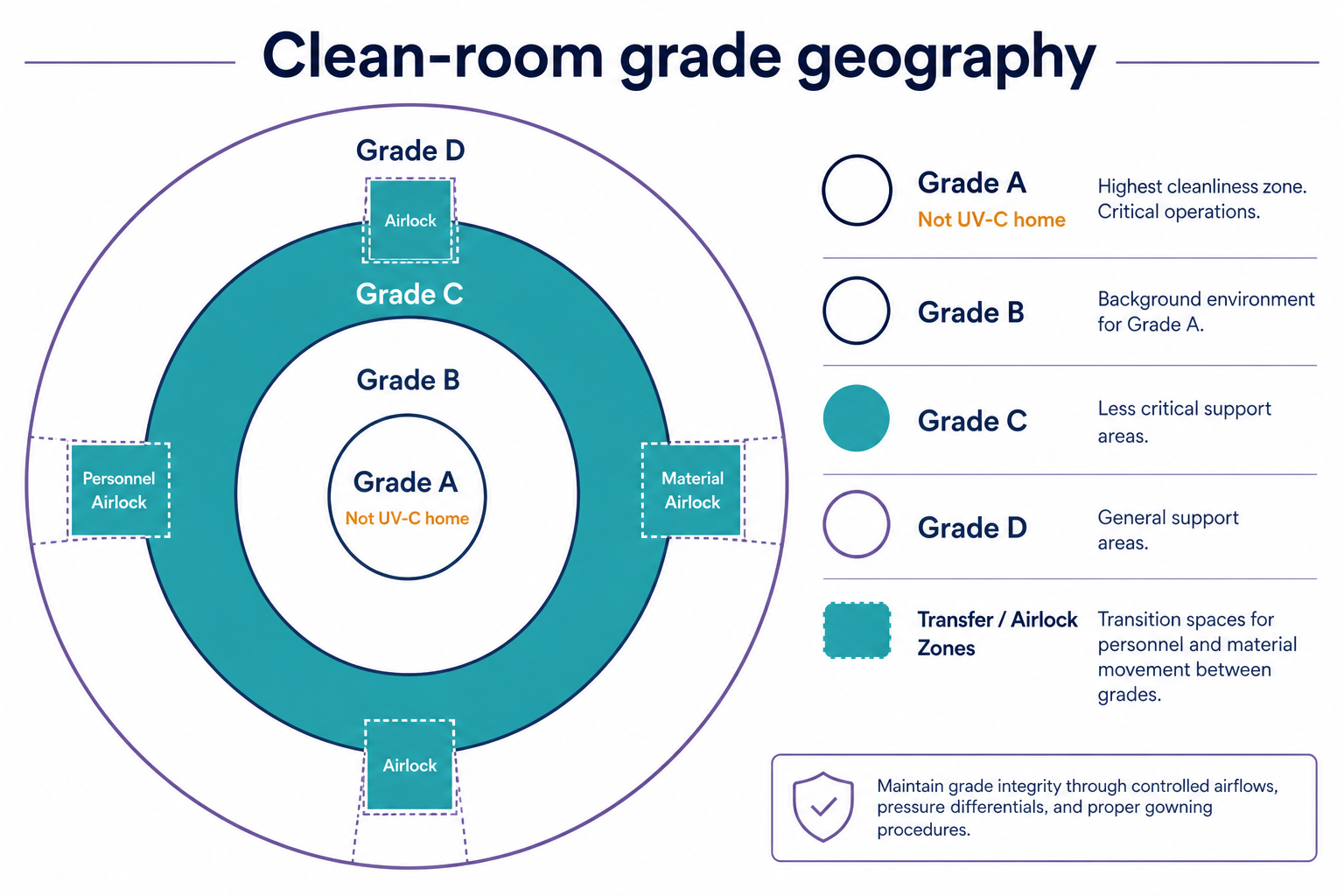
Grade A is the critical zone for high-risk operations such as filling and connections under unidirectional airflow. Grade B typically surrounds A. Grades C and D support preparation, less critical steps, and material pathways.
UV-C’s realistic home is Grade C/D support areas, airlocks, material-transfer zones, corridors, and gowning areas—not the Grade A point of fill. Pitching UV-C as a Grade A intervention misunderstands Annex 1’s reliance on airflow design, first-air principles, and validated processes at the critical point.
Map your facility before you buy hardware. If the proposed deployment cannot be drawn on a grade diagram without crossing into A, stop and rewrite the rationale—or discard the use case.
Legitimate Use Cases—Modest and Documented
Where adjunct UV-C can earn a CCS line:
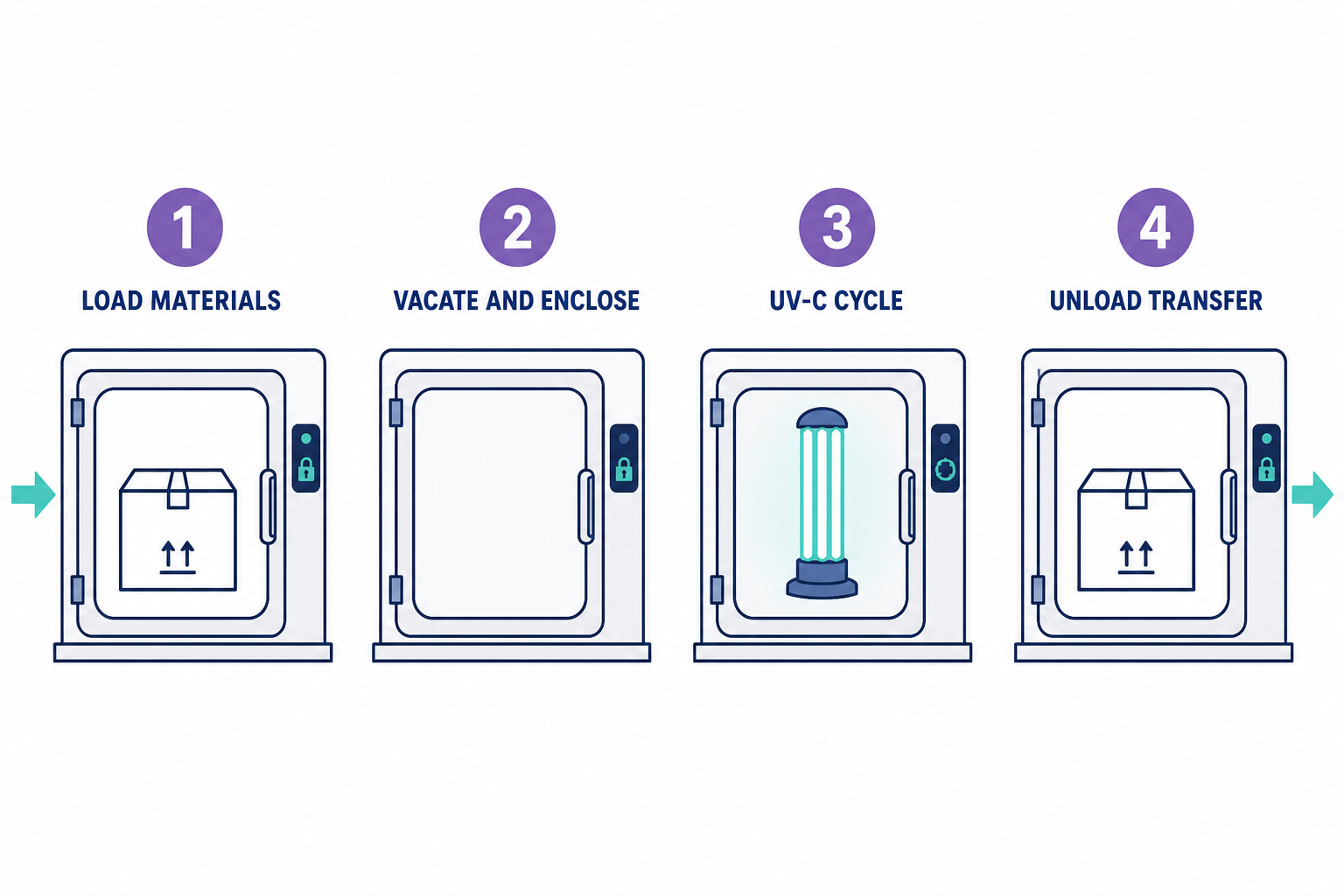
- Material airlock / pass-through treatment — after wipe-down with qualified disinfectants, a vacated enclosed chamber cycle between loads; never a substitute for transfer SOPs
- Room treatment after interventions or shutdowns — when C/D space can be cleared and returned under change control alongside cleaning, agents, and EM clearance
- Support-area routine adjunct cycles — corridors, gowning anterooms, and C/D preparation spaces between EM sessions, aimed at consistency rather than EM silence
Personnel must vacate before any cycle. The enclosed room (solid walls, closed door) remains the safe unit—same doctrine as hospital vacated-room practice. Never run UV-C in occupied clean-room volumes.
Every use case should name the grade, the vacant-room rule, the surfaces in line of sight, and the EM locations that will judge success. If those four cannot be written into the CCS, the use case is not ready.
What the QA File Needs
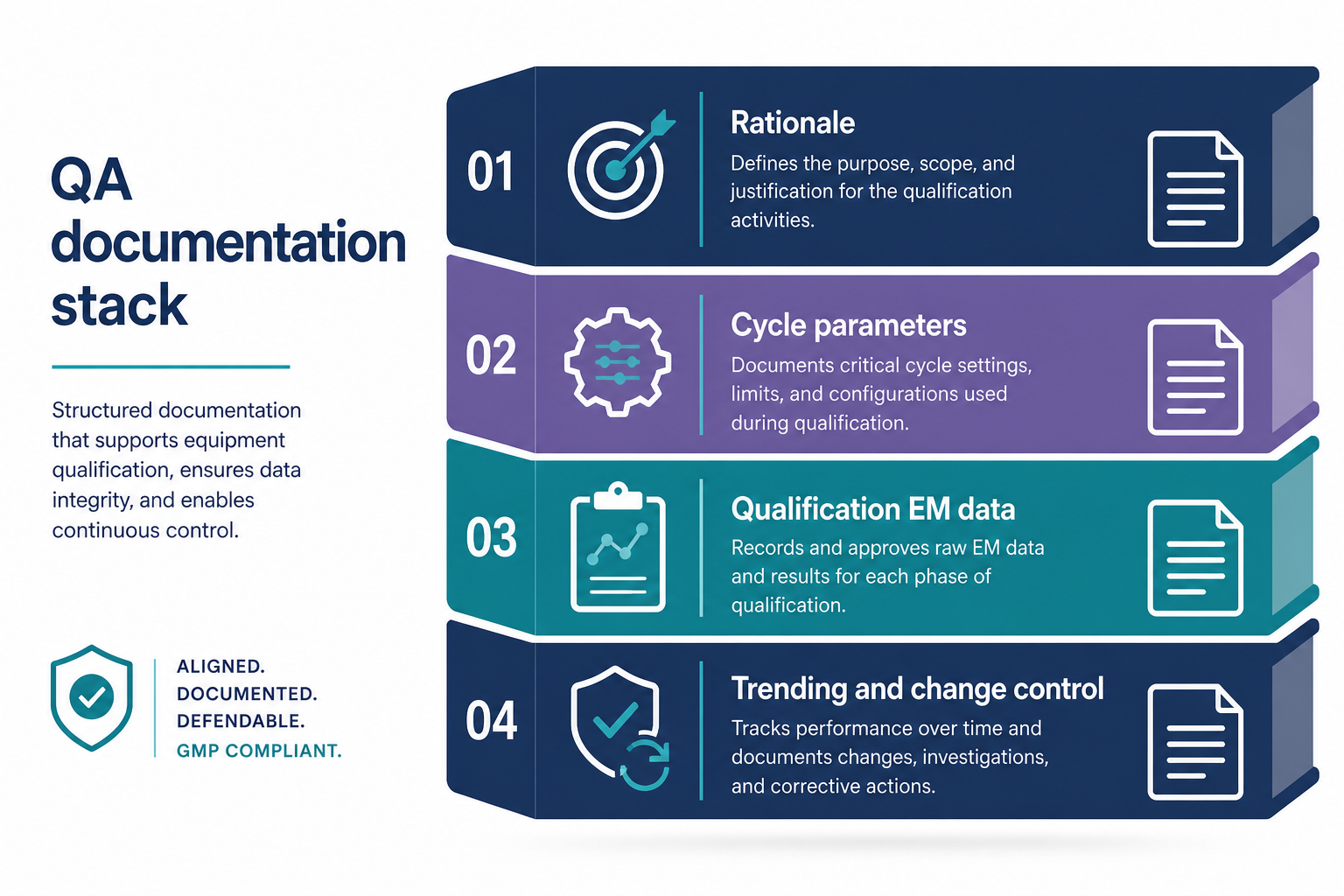
Like everything in GMP, UV-C without paperwork is a liability; with paperwork it can be an asset:
- Documented rationale inside the CCS
- Defined cycle parameters (and how they stay true as lamps age)
- Qualification evidence—before/after EM data at defined locations
- Change control when parameters, equipment, or geography shift
- Trending that shows the adjunct is not drifting into superstition
Lamp-hour logs and radiometer checks belong with that file. Assuming output from glow alone fails the same honesty test manufacturing QA already applies to qualified disinfectants and HEPA certification. Pair measured-output discipline with this CCS framing—the lamp-lifespan article covers that verification habit in detail.
Change control should capture lamp replacements, recipe edits, and relocation of units between rooms. Orphan devices that wander without a change record become unexplained EM noise. Review cadence matters: if trending no longer supports the rationale, retire or revise the adjunct rather than defend a decorative control.
Interaction with Existing Controls
UV-C complements—never replaces—HEPA filtration, pressure cascades, gowning discipline, and validated disinfectant rotation with qualified disinfectants. Sporicidal agent stages exist because bacterial spores resist many interventions, UV dose included. Agent rotation stays. First-air and unidirectional design at Grade A stay.
Engineering and microbiology should co-own boundaries: where UV-C may run, how EM proves value, and what happens when EM or pressure alarms say the facility is not in a state to add another variable.
If pressure cascades or HEPA integrity are in question, do not use UV-C as a distraction project. Fix the primary controls; revisit adjuncts only when the CCS foundation is stable. The hierarchy is deliberate: designed air and chemistry first; physical adjuncts last and only where justified.
Honest Caveat: Marginal Gains, Not Transformation
The honest caveat
In a well-run facility, UV-C is a marginal-gains layer and a consistency tool—not a transformation of the CCS. Any vendor pitching it as a Grade A fill intervention misunderstands Annex 1. Precision over persuasion: keep UV-C in C/D support and transfer geography, under documentation, or do not buy the story.
Honest procurement language helps: “adjunct for vacant C/D and transfer zones, qualified against EM at named locations, reviewed under change control.” Anything louder belongs in marketing, not the QA file. If foundations are weak, buy engineering time before you buy lamps.
Key Takeaways
- CCS thinking: every control justified, assessed, monitored—including adjunct UV-C.
- Realistic geography: C/D support, airlocks, transfer, gowning—not Grade A fill.
- Vacate and enclose before cycles; UV-C never runs in occupied volumes.
- QA file: rationale, parameters, EM qualification, change control, trending.
- Complements HEPA, pressure, and agent rotation; sporicidal stages remain; expect marginal gains, not transformation.
Frequently Asked Questions
Can UV-C replace a validated disinfectant?
No. It does not substitute for qualified disinfectants or cleaning agents, nor for HEPA and airflow controls.
Is Grade A a suitable UV-C deployment zone?
No. Grade A depends on designed airflow and process controls at the critical point. UV-C’s realistic home is C/D support and transfer geography.
What EM evidence should we expect?
Defined locations, before/after data under qualification, then trending under routine use—owned by QA, not by a vendor brochure.
Do spores change the story?
Yes. Sporicidal agent stages exist because spores resist many interventions, including UV dose. Keep agent rotation.
Where does SpotlessAI fit?
SpotlessAI can discuss vacated-room adjunct UV-C programmes for support-area CCS lines with QA and engineering—without claiming Grade A roles or publishing efficacy theatre in this article. Talk to our team.
Conclusion
Speak Annex 1 fluently and UV-C finds a small, honest door: support geography, vacated cycles, documented parameters, EM that can prove or kill the claim.
Refuse Grade A myths. Keep HEPA, pressure, and agents at the centre. Treat UV-C as marginal gains with paperwork—or leave it out.
When QA and engineering want a precise CCS conversation, the SpotlessAI team is ready.