
ATP testing hospital cleaning programmes often get compared as if every meter and swab answered the same question. They do not. Fluorescent markers, ATP bioluminescence, and culture swabs measure different layers of “did cleaning work?â€â€”process contact, organic residue, and viable organisms. Mix the methods up and you will misread both housekeeping performance and any UV-C adjunct that follows manual cleaning.
This article is a neutral explainer for designing a monitoring programme—not a product pitch. For how marker studies reveal wipe gaps, see manual cleaning misses surfaces. For how log reduction language differs from field swabs, see UV-C log reduction explained. For filing verification into accreditation evidence, see NABH infection control documentation.
Why Verification Exists
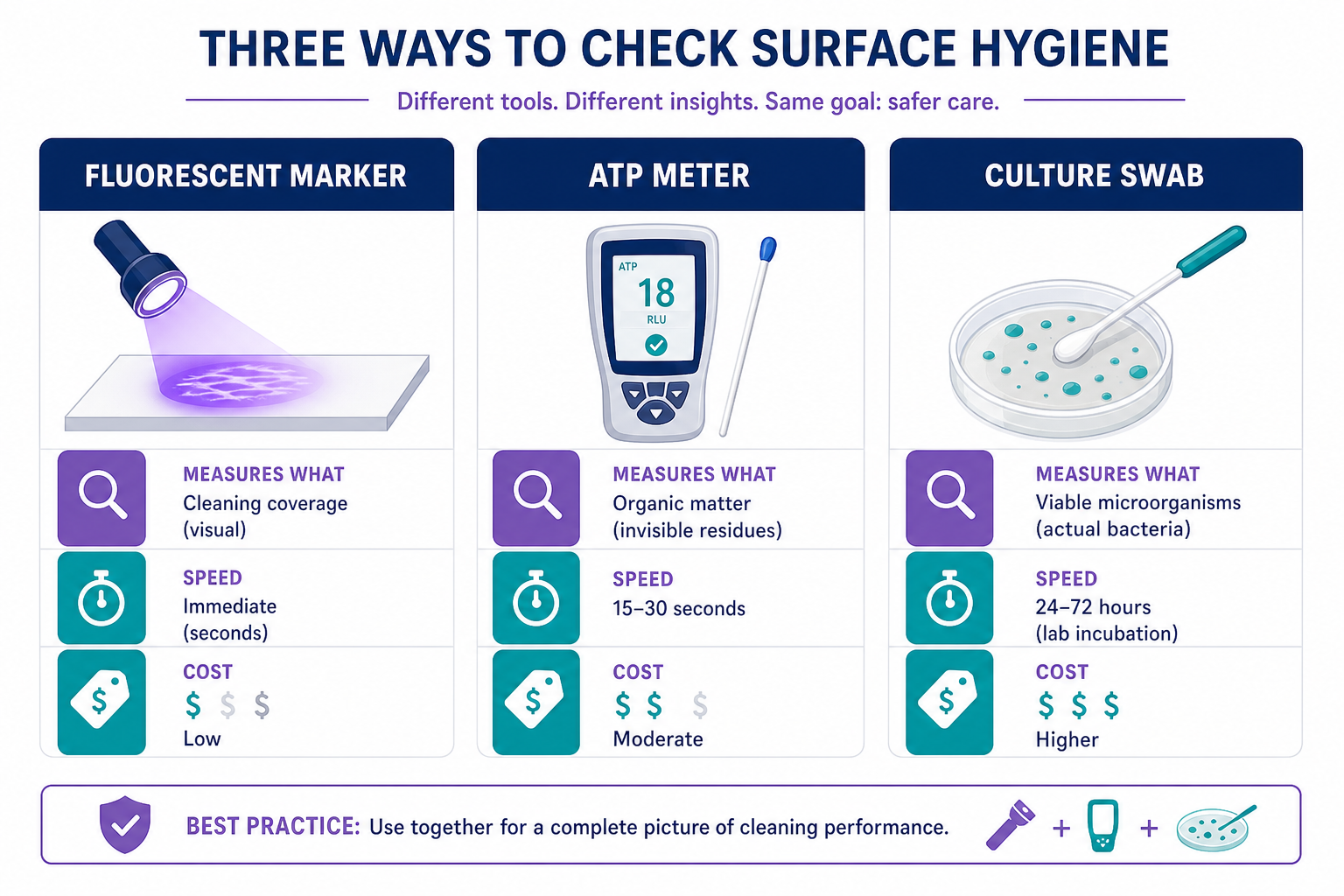
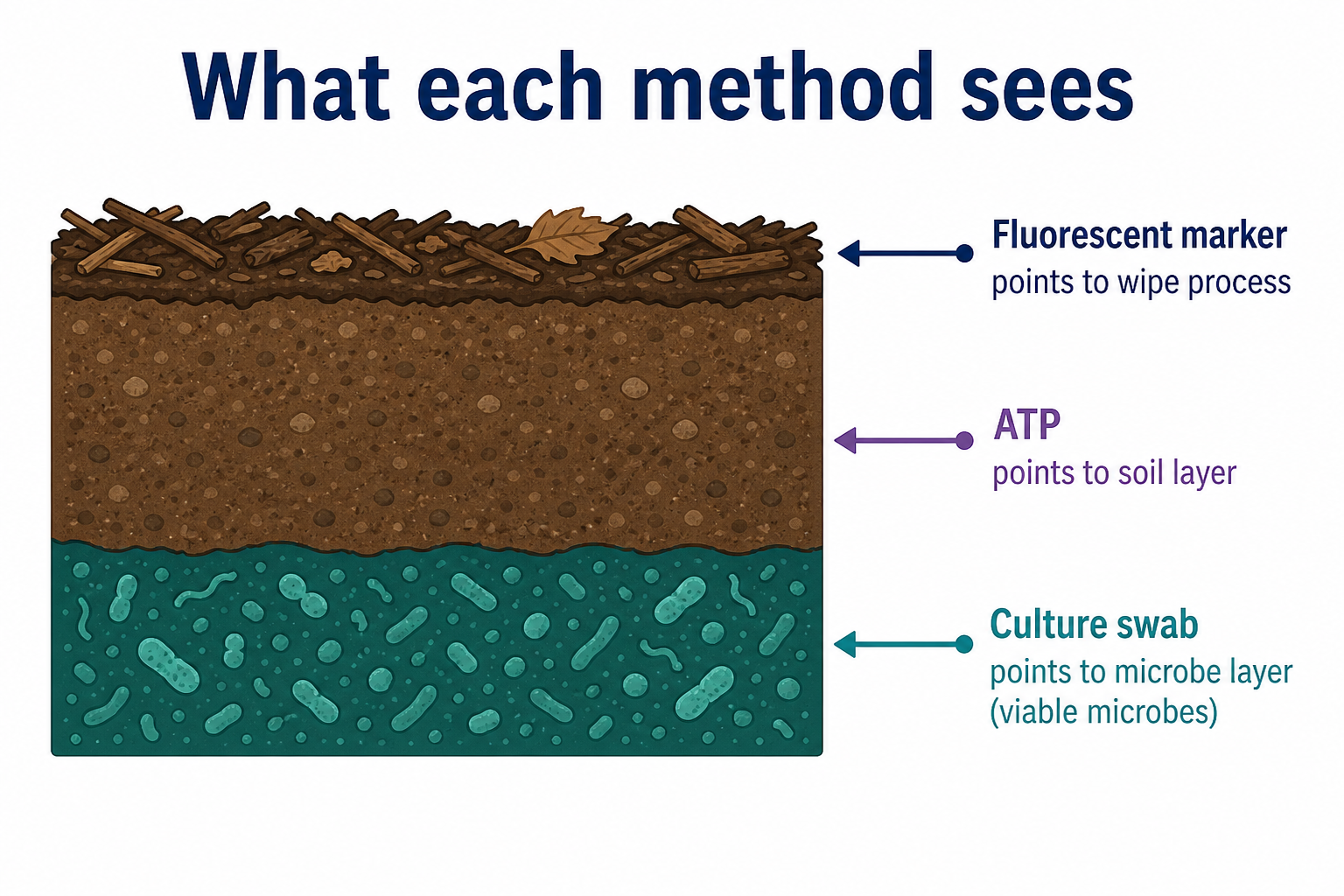
Cleaning that is not measured drifts. Visual inspection alone cannot see microbes or confirm that a wipe contacted every high-touch object. Hospitals therefore add objective checks. The three common tools answer three different questions:
- Was the surface wiped? — fluorescent markers
- Is organic residue still present? — ATP
- Are viable organisms still recoverable? — culture swabs
Public-health guidance on evaluating environmental cleaning—including fluorescent markers and related methods—is summarised in resources such as the CDC environmental cleaning pages. Choose the tool that matches the question you actually need answered.
Fluorescent Marker Cleaning Audit: Process Compliance
Invisible fluorescent gel placed on high-touch objects before terminal cleaning, then checked with a UV lamp, measures whether wipe contact occurred. Landmark fluorescent-marker work (including Carling and colleagues in Infection Control & Hospital Epidemiology, 2008, and successor studies) showed how often high-touch surfaces are missed—and how feedback can lift thoroughness.
Markers are relatively cheap and fast. They are ideal for training and non-punitive feedback loops. They say nothing about microbes. A surface can be wiped and still harbour organisms; a miss on the marker is a process failure, not a CFU count.
ATP Testing Hospital Cleaning: What Bioluminescence Actually Measures
ATP bioluminescence meters report relative light units (RLUs) as a proxy for organic residue on a sampled surface. Results arrive in seconds. That speed makes ATP attractive for daily monitoring—but interpretation has hard limits.
Thresholds are device-specific and not safely inter-comparable between meter brands. ATP correlates imperfectly with viable organisms: residue can exist without recoverable CFU, and viable cells can exist where ATP is low. Treat RLU cut-offs as policy artefacts tied to a named meter and a cited source—not as universal “clean†numbers.
The UV–ATP trap: UV-C inactivates microorganisms; it does not remove soil. ATP readings therefore often change little after a UV cycle alone. A low ATP reading after a UV-C adjunct usually credits the pre-cycle manual clean that removed residue—not the light. Misreading that as “UV cleaned the room†invents a capability UV does not have. UV-C remains an adjunct after manual cleaning, never a replacement for wiping.
Surface Swab Culture Verification: Viable Organisms
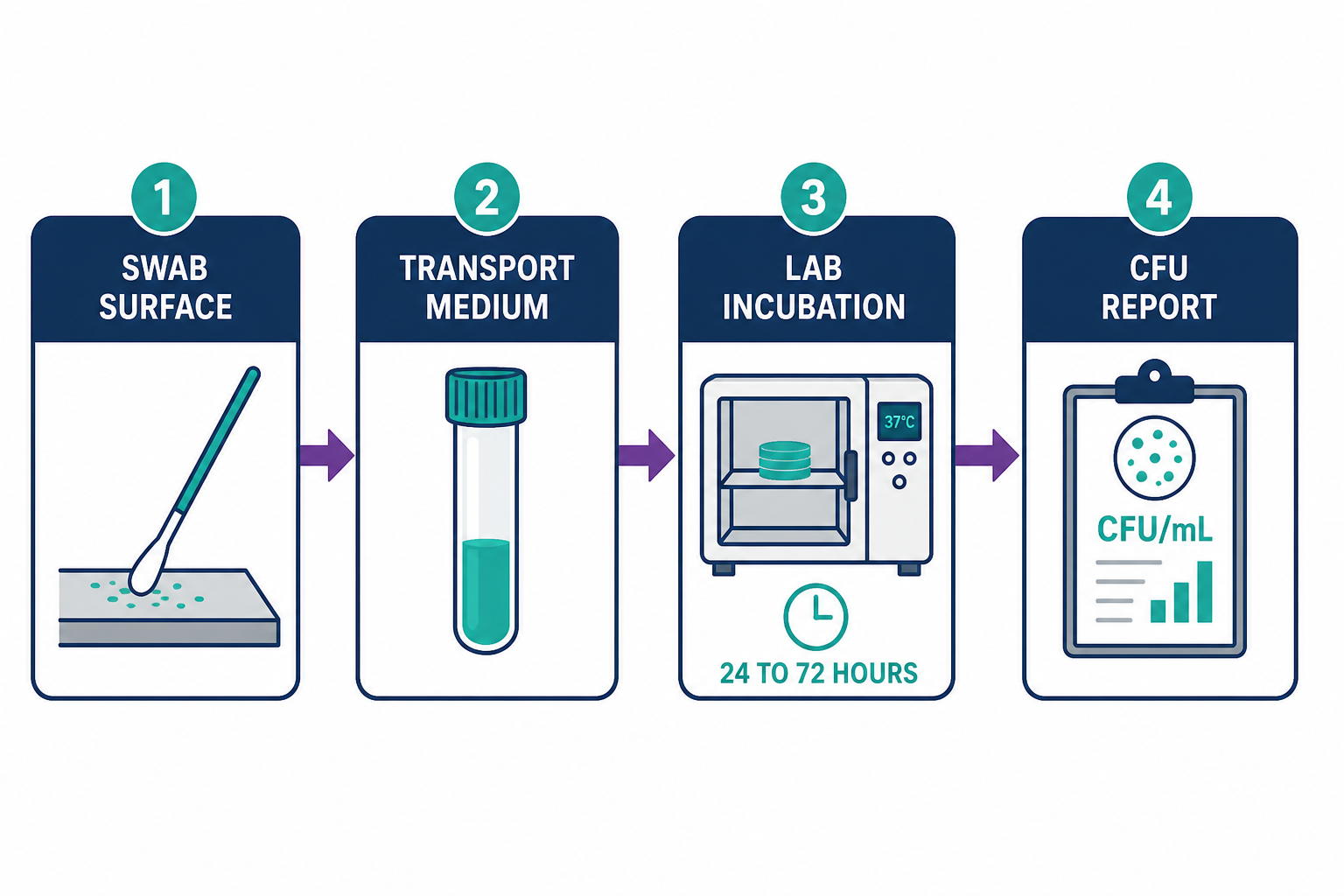
Culture swabs (and related environmental sampling plated for CFU) measure recoverable viable organisms. For many accreditation-minded reviews, culture is the gold-standard answer to “are organisms still there?†after a process change.
The trade-offs are real: samples need correct technique and transport, laboratory incubation typically takes 24–72 hours, and cost per point adds up. Facilities usually partner with a diagnostics lab and sample strategically—not every bed rail every day.
When hospitals validate UV-C deployments in the field, before/after culture sampling through an accredited lab is the method that speaks to viability. ATP and markers remain useful for other questions; they are not substitutes for CFU when viability is the claim under review.
Building a Verification Programme
Design the programme as policy, not as improvisation:
- Which method for which question (markers for wipe training; ATP for residue surveillance; culture for viability claims).
- Which surfaces — a defined high-touch list by room type.
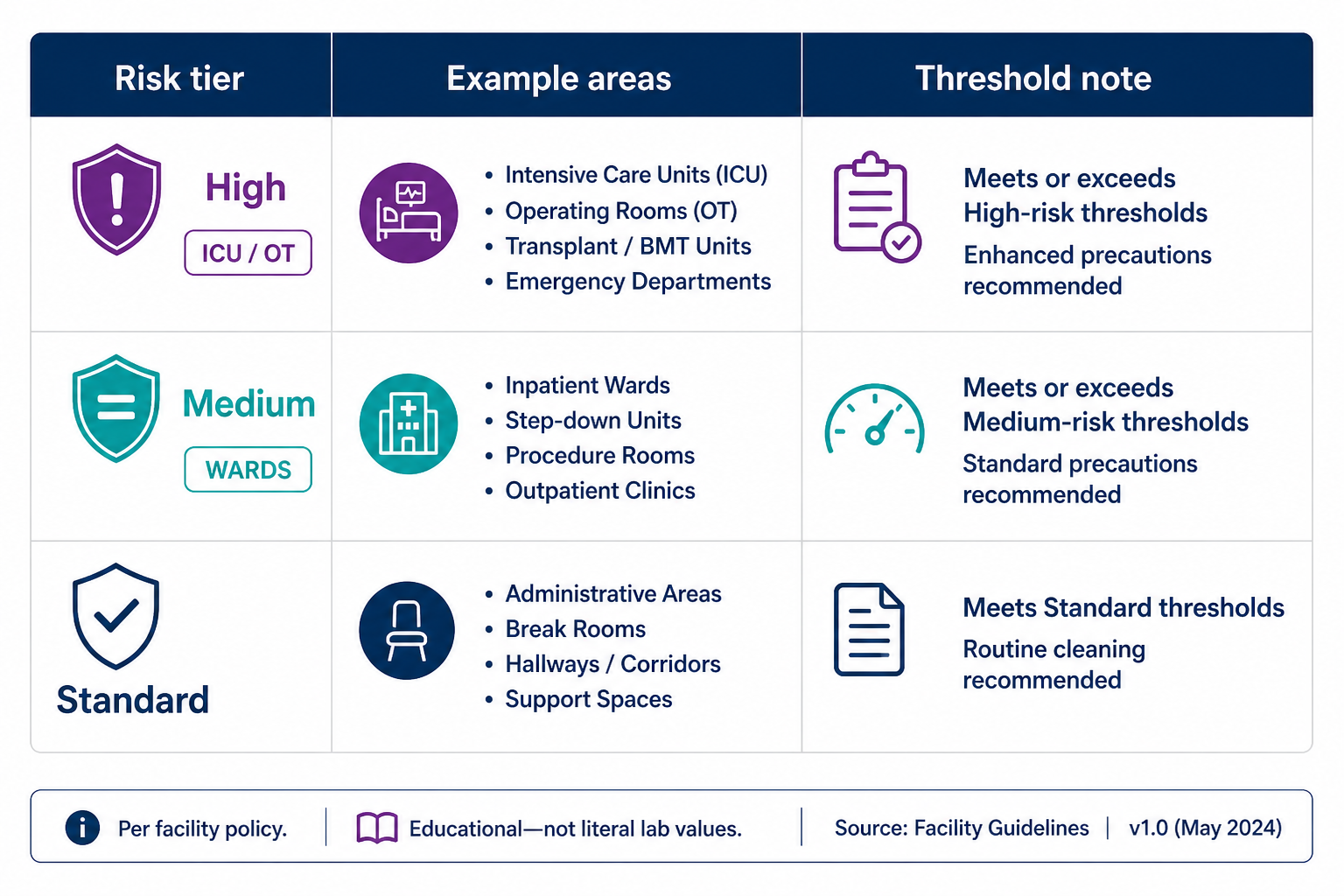
- What frequency — risk-tiered (ICU/OT denser than general wards).
- What thresholds — printed in facility policy with a cited source, versioned so historical results keep their original context when cut-offs change.
Do not copy another hospital’s RLU number without matching meter, method, and risk context. Thresholds that travel without their citation become folklore.
Honest Caveat: ATP After UV Is Not a UV Efficacy Score
The honest caveat
A low ATP reading after a UV-C cycle mainly proves that cleaning removed residue—it is the pre-cycle manual clean being verified. The culture swab is what shows the UV-C effect on viable organisms. Use each tool for its layer, or you will credit the wrong step in the stack.
Key Takeaways
- Markers, ATP, and culture swabs answer wipe contact, residue, and viability—three different questions.
- Fluorescent marker audits train process compliance; they are silent on microbes.
- ATP is fast but brand-specific; do not inter-compare RLUs across meters or treat ATP as CFU.
- UV-C does not “clean†soil—low ATP after UV usually credits manual cleaning.
- Culture swabs remain the viability gold standard when turnaround and lab partnership allow; thresholds belong in versioned facility policy.
Frequently Asked Questions
Can we use one ATP meter’s thresholds with another brand?
No. RLU scales and cut-offs are device-specific. Keep thresholds tied to the named meter in facility policy.
Does a clean ATP result prove UV-C worked?
Not reliably. ATP tracks residue. UV-C targets viability without removing soil. Use culture when you need a viability answer.
Are fluorescent markers enough for accreditation evidence?
They support process-compliance monitoring and training. Accreditation-minded programmes usually combine methods and document verification in the wider evidence chain—not markers alone.
How often should we culture swab?
Set frequency by risk tier and policy—denser in ICU/OT change programmes, lighter for routine ward surveillance—balancing lab cost and decision value.
Where does SpotlessAI fit?
Spotbot UV-C by SpotlessAI is an adjunct after manual cleaning in vacated enclosed rooms. Field validation conversations typically emphasise culture-based before/after sampling with a diagnostics partner—not ATP as a UV scorecard. Talk to our team if you want to align verification questions with your hygiene stack.
Conclusion
ATP testing hospital cleaning debates clear up when each method is assigned its layer. Markers police wipe contact. ATP tracks residue. Cultures settle viability. Thresholds live in versioned policy with citations—not in hallway folklore.
Respect the UV–ATP trap and you will stop giving light credit for what cloth achieved. Match the tool to the question and your monitoring programme starts telling the truth.
If your IPC team wants a calm walkthrough of verification design alongside terminal UV adjuncts, the SpotlessAI team is ready when you are.