
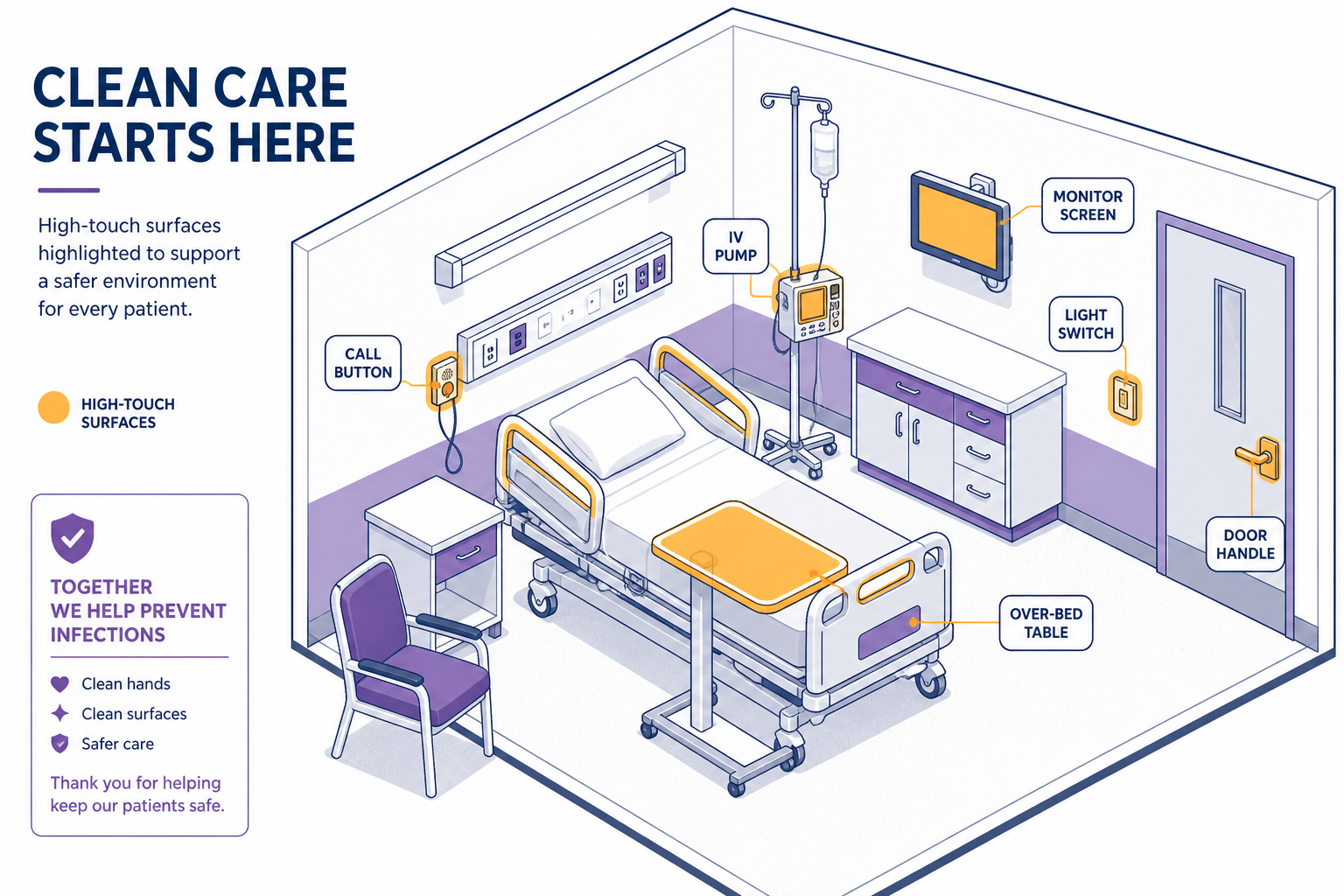
Manual cleaning misses surfaces hospital teams depend on every day—not because EVS and housekeeping lack professionalism, but because terminal cleaning is a high-variability human process under time pressure. Fluorescent-marker studies have repeatedly shown that a substantial share of high-touch objects are not thoroughly wiped after a room is vacated.
This article treats that finding as a system gap. Manual cleaning remains essential for soil removal. The question is how hospitals reduce residual variability with education, feedback, and—where appropriate—a no-touch adjunct, without blaming the people who keep wards running.
For how surface hygiene sits inside the wider HAI problem, see hospital acquired infections India. For honest limits of germicidal UV later in the stack, see UV-C disinfection limitations.
Manual Cleaning Misses Surfaces Hospital Marker Studies Keep Revealing
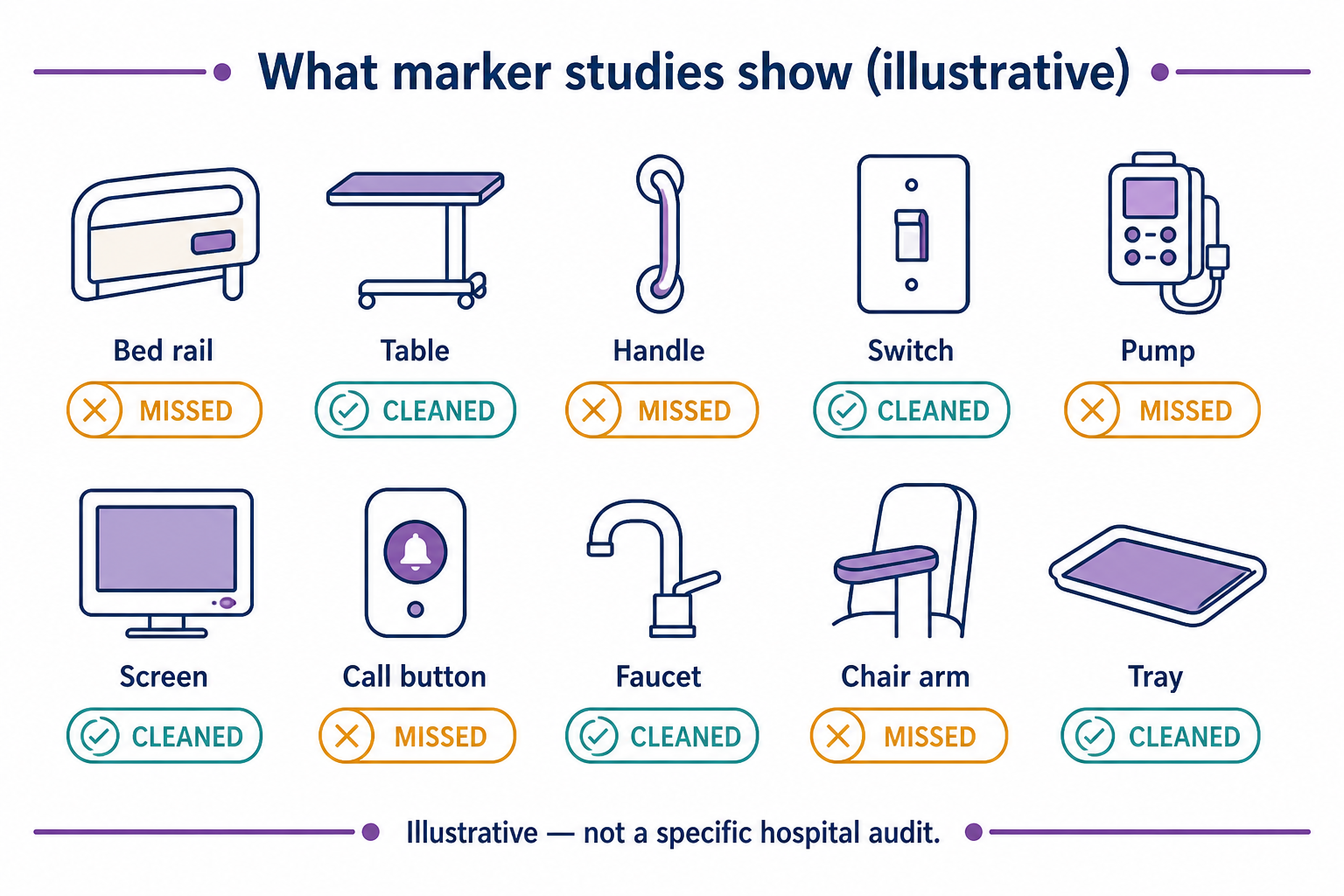
When infection-control researchers mark high-touch objects with invisible fluorescent gel and then assess rooms after terminal cleaning, they are not grading “effort.†They are measuring whether a wipe contact actually occurred where it should.
Landmark work by Carling and colleagues—including findings published in Infection Control & Hospital Epidemiology (2008) and successor studies—showed that thoroughness of disinfection cleaning for marked high-touch surfaces often landed in a roughly 40–50% range in many hospitals before structured improvement programmes. Later fluorescent-marker literature has continued to document incomplete coverage at terminal clean, with variation by facility and object type.
Those percentages are not an indictment of individual cleaners. They are a signal that unaided visual inspection and checklist culture alone leave predictable misses—especially on objects that look clean, sit in awkward reach zones, or sit outside a rushed mental map of “the bed area.â€
See also the CDC’s framing of environmental cleaning evaluation methods, including fluorescent markers, as tools to improve thoroughness rather than to shame teams (CDC environmental cleaning resources).
Why It Happens: System Pressures, Not Personal Failure
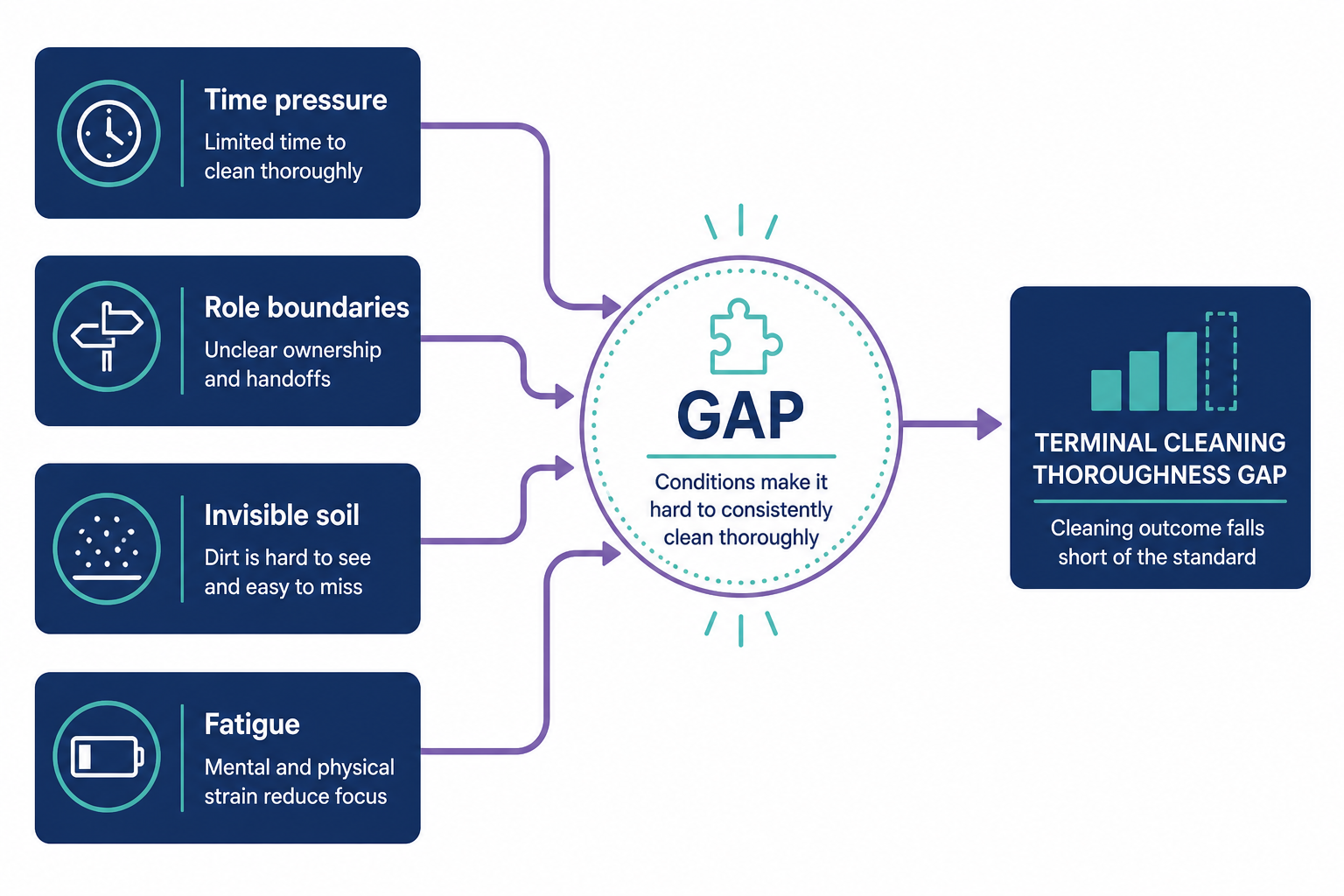
Terminal cleaning sits at the intersection of bed pressure, staffing, and invisible soil. Understanding the causes keeps the conversation operational:
- Time pressure and turnover — vacated rooms must reopen quickly; thorough wipe sequences compete with census targets.
- Invisible soil — many microbial loads leave no reliable visual cue; “looks clean†is a weak completion signal.
- Role boundaries — some equipment is “nursing’s,†some “EVS’s,†some “biomed’sâ€; ambiguous ownership creates systematic skips.
- Fatigue and sequence drift — long shifts and interrupted workflows make last objects on the list easiest to miss.
None of these are solved by slogans. They are solved by clearer ownership maps, realistic cycle times, feedback that is specific and non-punitive, and process design that assumes variability rather than perfection.
High Touch Surface Disinfection: The Hit-List That Marker Studies Keep Finding
High touch surface disinfection programmes succeed when the “hit-list†is explicit, trained, and audited—not left to memory. Across marker studies and IPC guidance, the same objects recur:
- Bed rails and bed controls
- Over-bed tables and tray tables
- Nurse call buttons and remotes
- IV pumps and pole handles
- Door handles and push plates
- Light switches and socket surrounds
- Touchscreens, monitors, and keyboards in the bed space
- Bathroom grab bars, flush handles, and faucet levers when the room includes an ensuite
These surfaces are touched often by patients, visitors, and staff—and they reload hands between contacts. Prioritising them is not “extra cleaningâ€; it is aligning effort with transmission risk. Facilities that publish a short, photo-backed hit-list for each room type give EVS a shared map and give auditors a fair standard.
What Improvement Programmes Achieve—and Where They Plateau
Education plus structured feedback works. Hospitals that introduce fluorescent-marker audits, share results with teams, and coach missed objects typically lift thoroughness scores—often substantially—from baseline. That is a genuine win for patients and for EVS professionalism.
Then many programmes plateau. Scores improve, then wobble when staffing thins, when turnover spikes, or when feedback becomes infrequent. Human processes drift unless the measurement loop stays alive. Expecting 100% wipe completeness on every terminal clean, every shift, without system support is not respectful of real work; it is magical thinking.
The operational lesson is twofold: keep investing in training and non-punitive feedback—and design an environmental hygiene stack that does not depend on perfect human coverage alone.
The Adjunct Logic: Reduce Variability After Manual Clean
No-touch terminal disinfection—such as a UV-C cycle in a vacated room—does not replace wiping. Manual cleaning removes soil and organic load that block light and chemicals. The adjunct’s job is different: deliver a more consistent disinfection pass across exposed surfaces after the room is already cleaned, reducing the leftover variability marker studies keep documenting.
In one SpotlessAI field evaluation as a post-manual-clean adjunct at a 300-bed hospital, swab sampling across 1,000+ points supported 99.99% bacterial elimination under those conditioned programme conditions. That figure is not a claim that UV-C alone cleans dirty rooms, nor that every facility will replicate the same result without matching process discipline.
Used correctly, the sequence is clean → adjunct disinfect → verify. Used incorrectly—as a substitute for wiping—it inherits every limitation described in our guide to UV-C disinfection limitations.
Honest Caveat: UV-C Has Gaps Too—Layer the Defences
UV-C does not erase the thoroughness problem by magic. Line-of-sight physics means shadowed faces, undersides, and cluttered zones can receive inadequate dose unless cycles are designed for multi-position coverage and room prep. Those optics are covered in detail in UV-C shadowed surfaces.
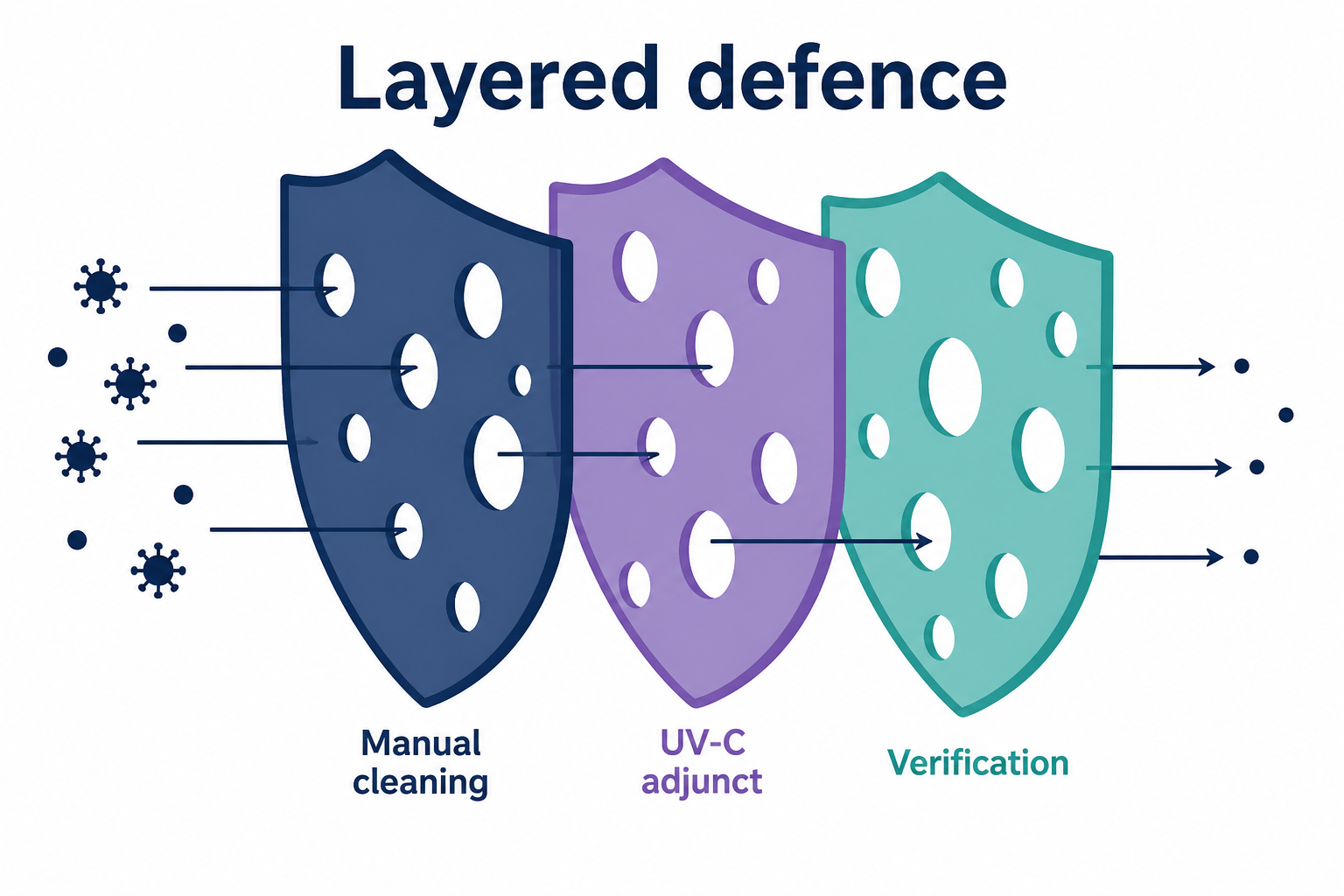
The honest model is therefore layered: manual cleaning + UV-C adjunct + verification. Manual work removes soil and reaches into contact-critical spots. UV-C reduces residual bioburden on exposed surfaces with less shift-to-shift variability. Verification—markers, ATP where used, swab programmes, cycle records—keeps both layers accountable.
Swiss-cheese thinking applies. Each layer has holes. Overlapping layers cover different misses. Selling any single layer as complete is the mistake this series exists to prevent.
The honest caveat
Manual cleaning will continue to miss some high-touch surfaces under real hospital conditions. UV-C will continue to miss some shadowed surfaces under real room geometry. The defensible programme combines both with verification—not blame, and not a single-technology promise.
Key Takeaways
- Marker studies repeatedly show roughly 40–50% thoroughness gaps on high-touch surfaces at baseline—treat this as a system finding.
- Time pressure, invisible soil, role boundaries, and fatigue explain misses without blaming EVS teams.
- Publish an explicit high-touch hit-list and audit it with non-punitive feedback.
- Education and feedback lift scores, then often plateau—design for residual variability.
- The honest stack is manual cleaning + UV-C adjunct + verification; each layer has its own gaps.
Frequently Asked Questions
Does “manual cleaning misses surfaces†mean cleaners are failing?
No. Fluorescent-marker research describes process thoroughness under real constraints. Respectful programmes fix systems—time, ownership, feedback, adjuncts—not people.
What is a fluorescent marker audit?
Invisible gel is applied to high-touch objects before cleaning; UV lamps reveal whether wipe contact removed the mark. It measures contact completeness, not chemical kill.
Can UV-C replace terminal wiping?
No. Soil and organic load must be removed first. UV-C is an adjunct after manual clean, and it still needs shadow management and verification.
Which surfaces should we prioritise?
Bed rails, over-bed tables, call buttons, IV pumps, handles, switches, and touchscreens in the bed space are consistent high-touch priorities—adapt the list to each room type.
Where does SpotlessAI fit?
Spotbot Lite by SpotlessAI is positioned as a post-manual-clean UV-C adjunct for vacated rooms, paired with process discipline and records—not as a substitute for EVS work. Talk to our team if you want to explore that layered model for your facility.
Conclusion
Manual cleaning misses surfaces hospital leaders should treat as predictable—not scandalous. Marker studies made the gap visible; human-factors analysis explains it; improvement programmes narrow it; adjuncts and verification harden what remains.
Keep EVS at the centre of soil removal. Add no-touch disinfection where it reduces variability. Measure both layers. That is high-touch surface disinfection done with integrity.
If your infection-prevention team wants a calm conversation about layered terminal processes—without staff blame or silver-bullet claims—the SpotlessAI team is ready when you are.