
UV-C shadowed surfaces are the industry’s most inconvenient truth. Light travels in straight lines; hospital rooms are full of furniture; most materials reflect germicidal UV poorly. Pretending otherwise is how vendors lose assessor trust.
This article owns that blind spot: where shadows live, how multi-position cycles and room prep shrink them, and why flagging what you could not reach is more credible than claiming total coverage. For the broader can/cannot framing, start with UV-C disinfection limitations.
Biomedical engineers, EVS managers, and technically minded infection-control officers already know rooms are not empty boxes. The differentiator is a supplier that designs for that reality instead of denying it.
UV Disinfection Line of Sight: Why Shadows Are Inevitable
Germicidal UV is light. Photons leave the emitter and travel in straight lines until they are absorbed or weakly scattered. Anything opaque in that path—a mattress edge, a monitor back, a closed drawer—casts a shadow where dose collapses.
Unlike visible light bouncing brightly off mirrors and glossy paint, UV-C reflects poorly off most hospital materials. You do not get free “fill light†that paints the undersides of beds. Application geometry therefore dominates outcomes; public-health UVGI references such as CDC/NIOSH guidance treat that geometry as a first-class variable for the same reason.
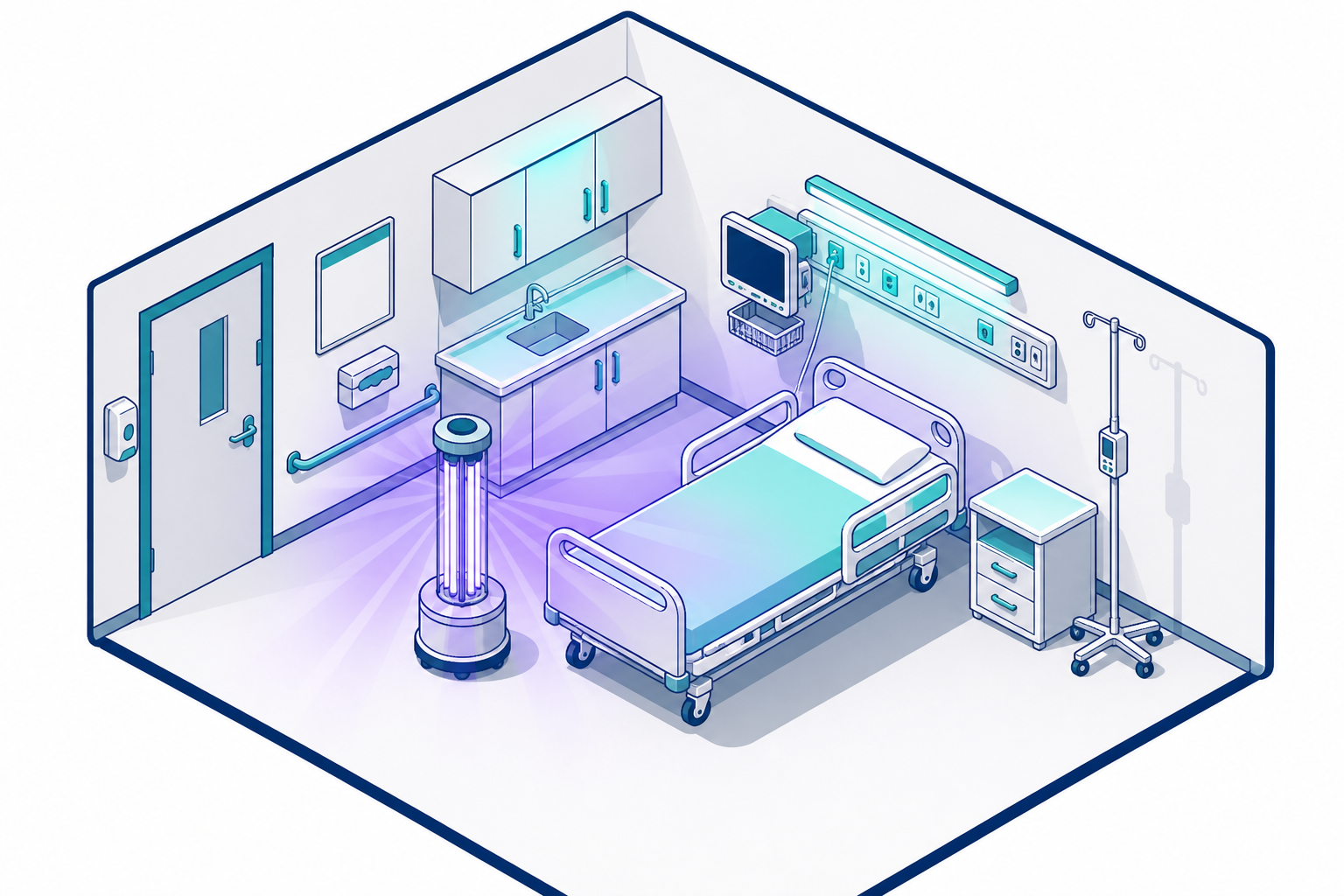
Where Shadows Live in a Patient Room
Walk a furnished room with a biomedical eye and the map is predictable:
- Under-bed surfaces and the far face of the bed frame
- Behind monitors, pendant booms, and wall-mounted devices
- Drawer interiors and cupboard cavities when closed
- Undersides of door handles and faucet levers
- The far side of IV poles, drip stands, and over-bed tables
Those locations are not exotic edge cases. They are the everyday geometry of acute care. A single emitter placed in the clear floor space will treat a large share of exposed high-touch faces—and systematically miss the shadowed set unless mitigation is planned.
Operators who inventory those zones during a pilot walkthrough usually find the list shorter than feared and more actionable than a vague “coverage†claim. Naming the surfaces is the first step toward managing them.
For wavelength and dose fundamentals that sit underneath this geometry, see how UV-C disinfection works.
Mitigation 1: Multi-Position Cycles
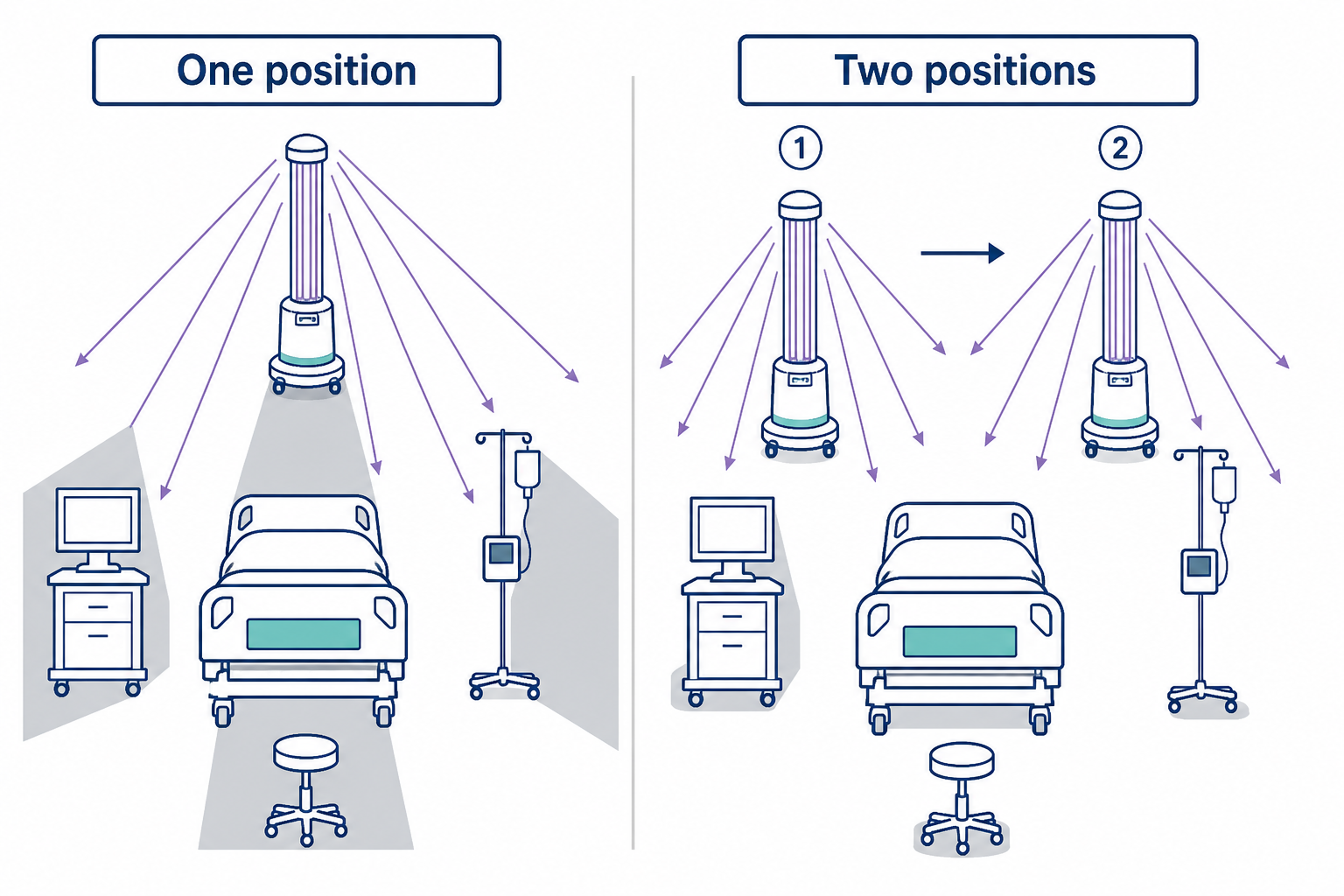
The first mitigation is geometric, not magical: treat the room from two or three robot positions. Each new viewpoint collapses shadows that the previous placement could not see.
A bed that blocked the under-frame from position A becomes reachable from position B on the opposite side. A monitor that cast a hard shadow toward the head wall may leave that zone open when the emitter moves nearer the foot. The remaining pockets shrink; they rarely vanish entirely in a densely furnished bay.
Cycle time rises with each position—operations must budget for that. The trade-off is honesty: fewer unreached surfaces, clearer follow-up lists, and a story assessors can follow.
Mitigation 2: Room Prep and Reflective Geometry
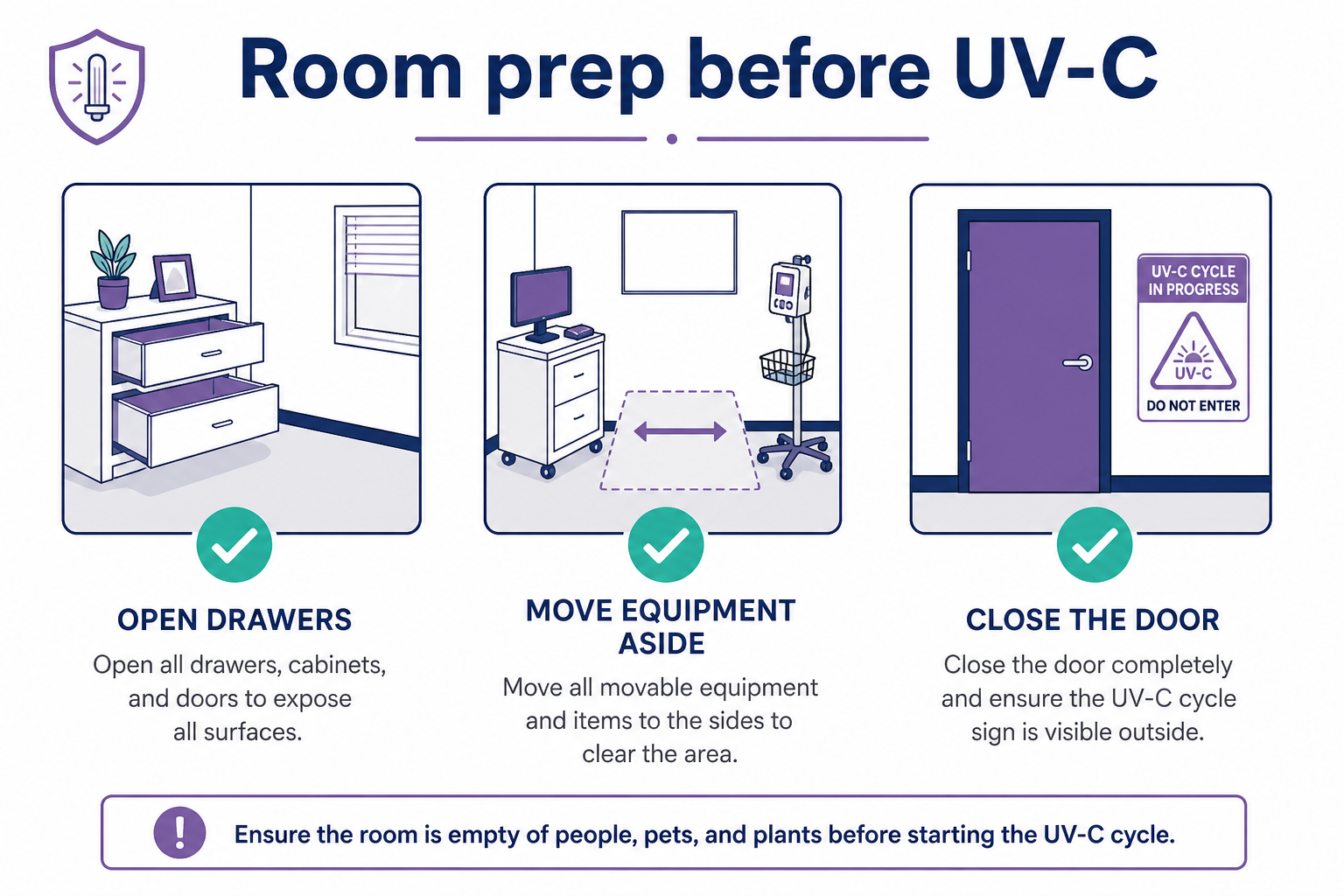
Before the cycle starts, EVS and nursing can change what the emitter can see. Open drawers and cupboard doors per protocol so interiors are no longer sealed cavities. Reposition movable equipment—chairs, over-bed tables, portable poles—out of hard shadow lines where clinically appropriate.
Close the room door. UV-C belongs in an enclosed, vacated volume; prep that leaves the optical space open is not a shortcut, it is a safety failure. Signage and interlocks reinforce that the room is off-limits until the cycle completes.
Room prep does not create perfect reflectance. It reduces avoidable shadows so the positions you do run are worth the time.
Mitigation 3: Flag and Follow Up
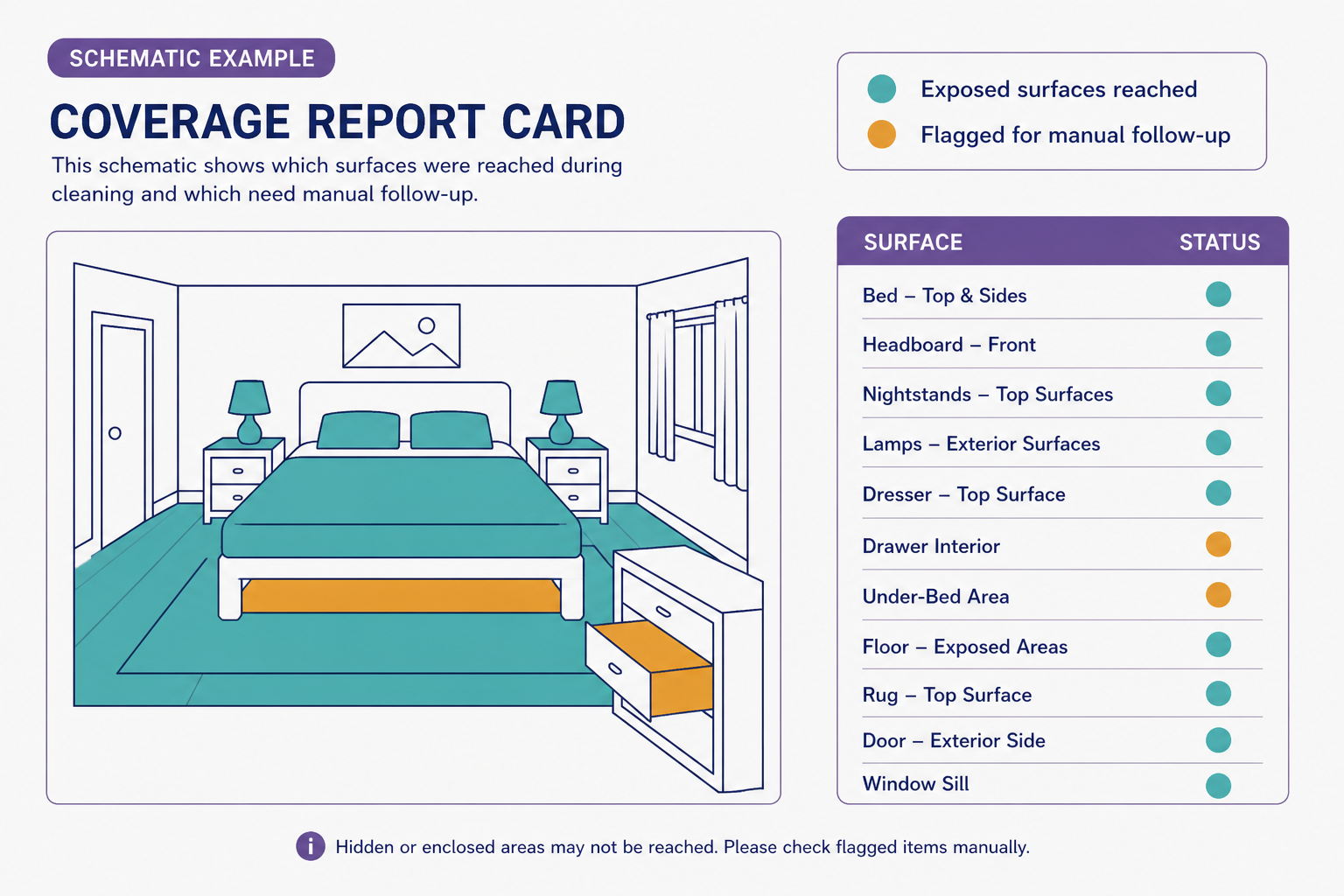
The decisive honesty move is reporting what the cycle could not reach. A system that maps or lists unreached surfaces and routes them to targeted manual disinfection gives an assessor a complete, defensible record.
Claiming total coverage of a furnished room does the opposite: it gives quality and survey teams a reason to distrust everything else in the file. Incomplete cycles, aborted runs, and shadowed zones belong in the exception trail—not in the marketing brochure.
For how signed, timestamped cycle evidence supports hospital documentation practice, see audit-ready UV disinfection records. The record model matters as much as the photons.
The honest caveat
No single-emitter UV-C cycle covers every surface in a furnished room. Anyone claiming otherwise is describing an empty one—or asking you not to look under the bed.
Key Takeaways
- UV-C shadowed surfaces are physics, not a vendor inconvenience—line of sight rules furnished rooms.
- Hospital materials reflect UV-C poorly; do not expect mirror-like fill light.
- Multi-position cycles collapse most shadow zones at the cost of more cycle time.
- Room prep—open drawers, move equipment, close the door—reduces avoidable shadows safely.
- Flagging unreached surfaces for manual follow-up is more credible than claiming total coverage.
Frequently Asked Questions
Why can’t one UV-C position treat an entire patient room?
Opaque furniture and equipment cast shadows. UV-C travels in straight lines and reflects poorly off most hospital materials, so undersides and far faces receive little or no dose from a single placement.
Do multi-position cycles eliminate all shadows?
They collapse most optical blind spots, but dense furnishings can still leave pockets. Those pockets should be flagged for targeted manual disinfection rather than ignored.
What room prep matters most before a UV-C cycle?
Open drawers and doors per protocol, reposition movable equipment out of hard shadow lines where appropriate, vacate the room, and close the door with clear signage. Prep supports optics and safety together.
Why is claiming 100% coverage a problem?
Assessors know furnished rooms cast shadows. A total-coverage claim invites distrust of the rest of the evidence trail. Reporting exceptions and follow-up builds a defensible file.
How does Spotbot approach shadowed surfaces?
Spotbot Lite by SpotlessAI is designed for vacated enclosed rooms after manual cleaning. Talk to our team about multi-position practice, room-prep protocols, and how unreached surfaces should be routed to manual follow-up in your SOPs.
Conclusion
UV disinfection line of sight is not a footnote—it is the operating constraint of every emitter in a real ward. Shadows live under beds, behind devices, and inside closed cavities.
Manage them with multi-position cycles, disciplined room prep, and flagged manual follow-up. That trio is how honest programmes turn an inconvenient truth into a defensible process.
If you want to pressure-test deployment geometry with the SpotlessAI team—not a coverage slogan—talk to us.