
UV-C safety occupied room questions usually arrive as staff anxiety: “Is it safe if we stand outside the curtain?†The answer must be sharper than reassurance. Germicidal 254nm UV-C is powerful enough to injure eyes and skin when people share the treated optical space—and the only reliable control is exclusion from an enclosed room.
This post states the doctrine plainly so nursing leadership, safety officers, and administrators can recognise unsafe shortcuts when a vendor or colleague proposes them. For how 254nm works on microbes—not people—see how UV-C disinfection works. For honesty about what UV cannot do in real rooms, see UV-C disinfection limitations.
Is UV-C Light Dangerous? What 254nm Does to Eyes and Skin
Yes—UV-C can injure people when exposure is uncontrolled. The two classic acute injuries are photokeratitis (a painful corneal “sunburn†of the eye, usually temporary) and erythema (skin reddening/burn). Effects are dose-dependent: intensity, distance, and time matter. That is why occupational photobiology frames exposure limits rather than casual proximity rules.
Prevention is not a theatre of goggles and coats inside an active beam path. The control hierarchy that actually works in hospitals is exclusion: no one in the optical volume while emitters run. PPE theatrics that keep staff “nearby but careful†are a weak substitute for a closed door.
Clinical and occupational literature on UV photokeratitis and cutaneous UV injury is long-standing; treat those injuries as foreseeable outcomes of occupied-room operation, not rare surprises. For standards context on photobiological risk classification for lamps and systems, see IEC 62471.
UV-C Safety Occupied Room Doctrine: No People, Ever
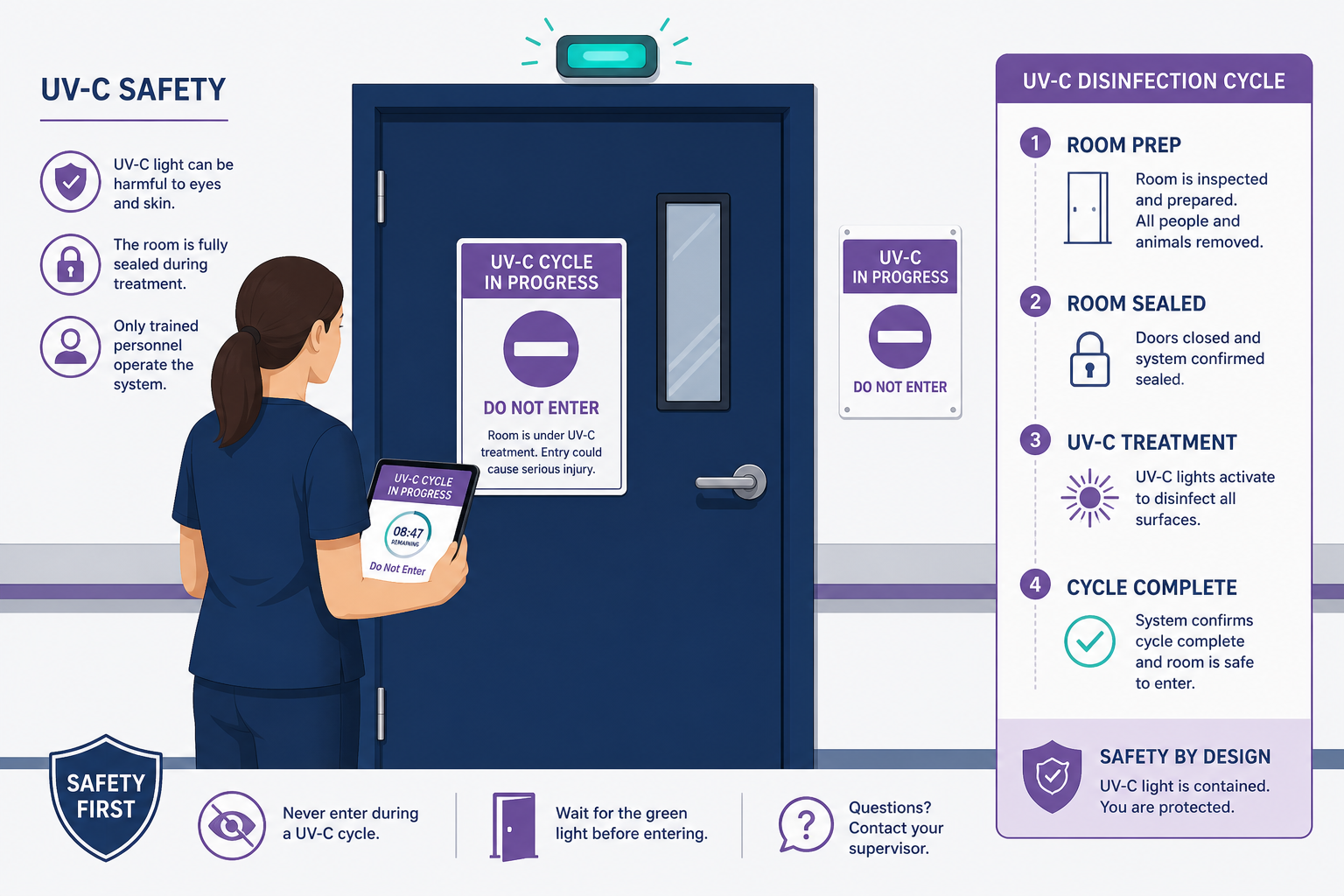
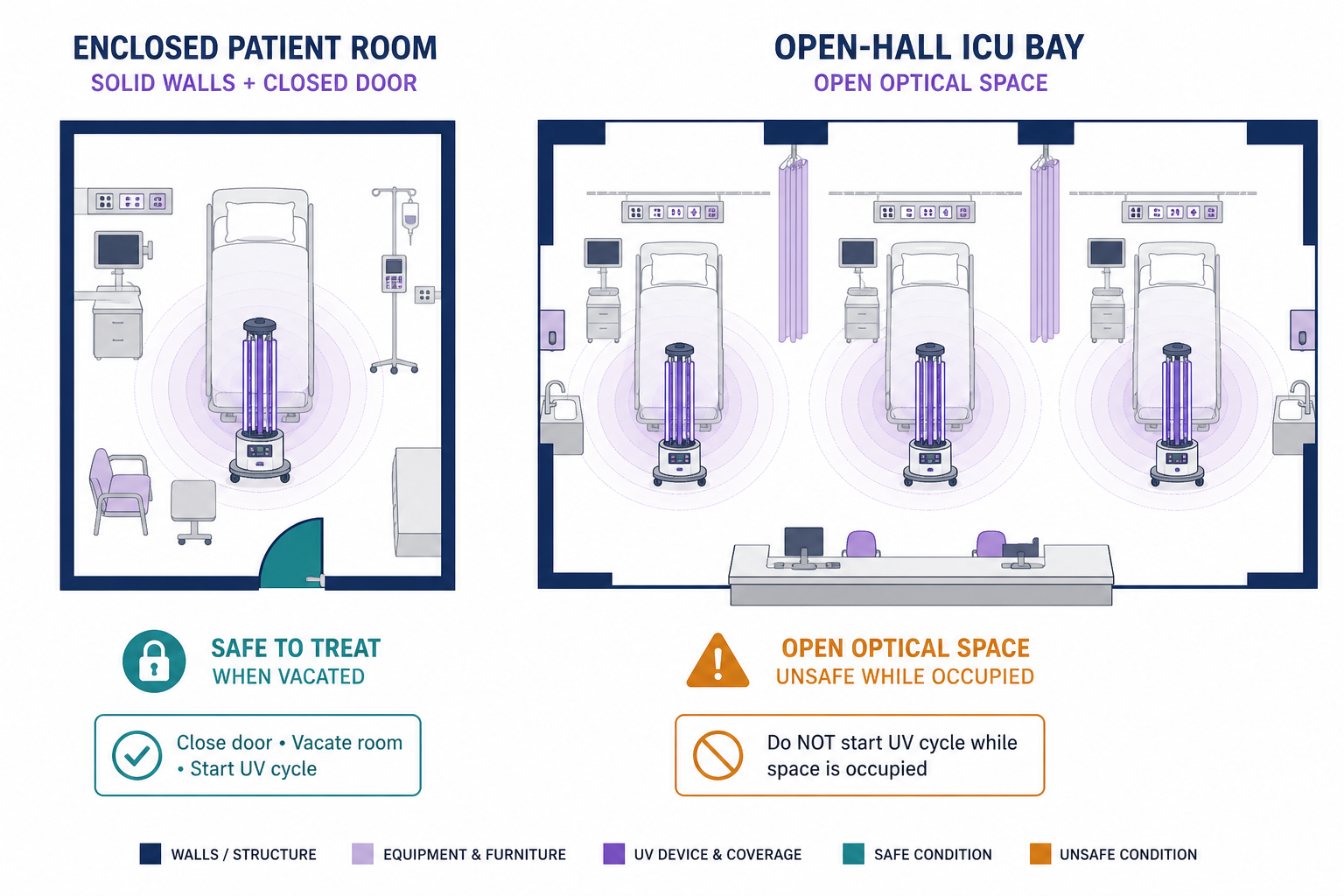
The doctrine is one sentence: UV-C never runs in occupied spaces. The safe unit of disinfection is the enclosed volume UV-C cannot escape into occupied corridors or neighbouring beds—solid walls and a closed door.
That unit is not a bed space. It is not a curtained bay. It is not “most of the room empty.” If a patient, visitor, or staff member remains inside the treated volume, the protocol has already failed—regardless of how short the cycle is.
SpotlessAI programmes treat this as non-negotiable for 254nm room systems. Terminal UV-C is an adjunct after manual cleaning in a vacated enclosed room—not a while-you-wait procedure beside an occupied bed. Emerging far-UVC (~222nm) research is a separate frontier with its own open questions—not a licence to run 254nm occupied; see far-UVC 222nm safety.
Why a Curtain Is Not a Barrier
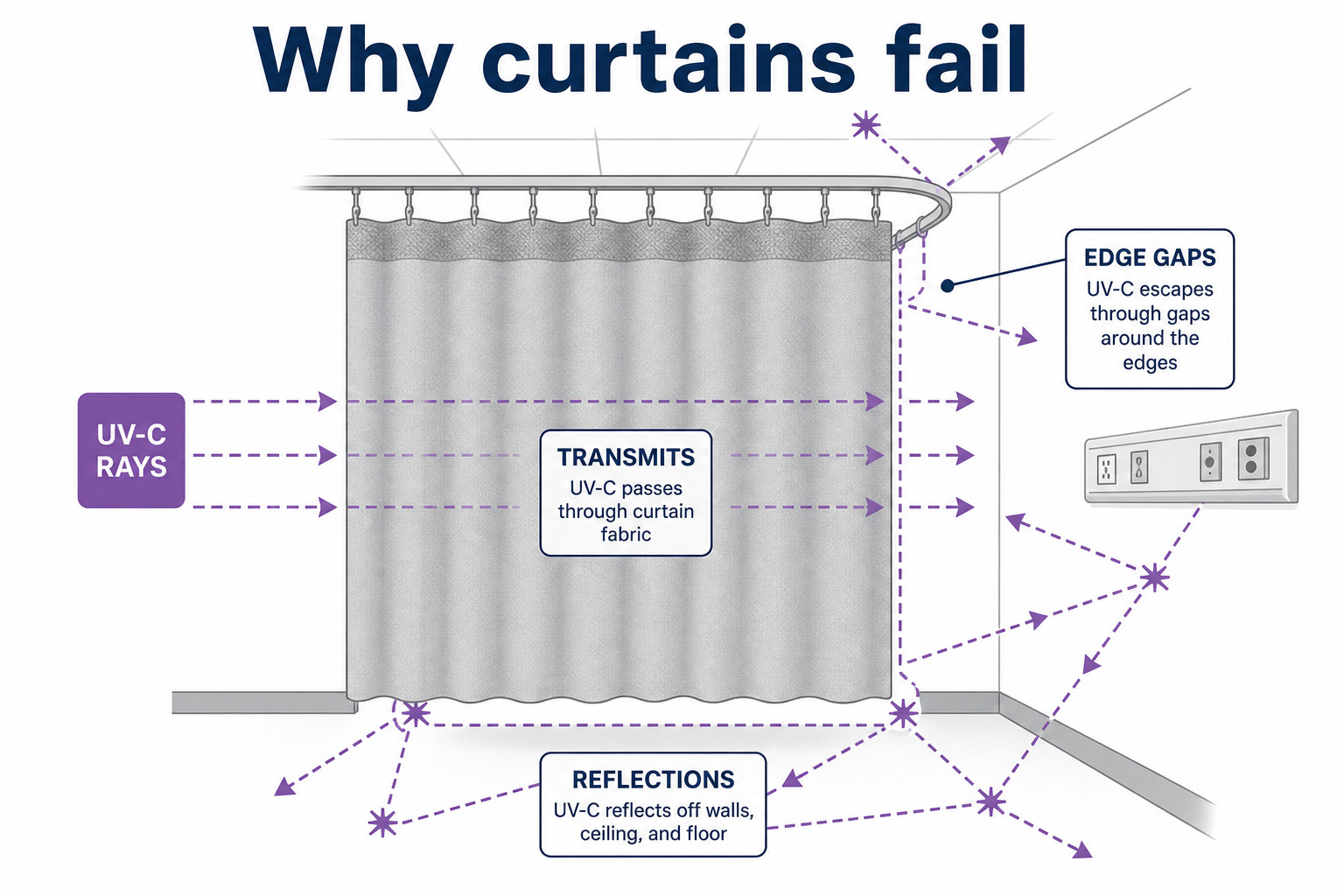
Privacy curtains feel like walls. Optically, they are not. Fabric can transmit and scatter UV. Edges leave gaps. UV-C also reflects from walls, ceilings, and floors—so rays that never aimed at a person can still reach them after a bounce.
“Standing far away†in the same open bay or hall is therefore not a defined-safe condition. Distance without enclosure is guesswork. Hospitals that treat curtains as PPE for UV are importing a false sense of control into a photobiology problem.
The Open-Hall Problem
Open-plan ICUs and multi-bed wards common in many Indian hospitals are often one continuous optical space. If UV-C can travel or reflect into any occupied bed or staff station, that entire hall is in play.
Consequence: you cannot run room-style UV-C while any patient or staff member remains present anywhere in that shared volume. Safe deployment means vacating and enclosing—or choosing a different hygiene strategy for that architecture. Pretending a mobile unit “only treats one bed†inside an open hall is how unsafe protocols get sold.
UV-C Exposure Limits and Safe Deployment Steps
UV-C exposure limits belong in the engineering and standards conversation—lamp risk groups under IEC 62471, and device safety practices aligned with ISO 15858:2016 for UV-C devices. Hospitals do not need to recite every clause; they do need a deployment sequence that keeps people below harmful exposure by design.
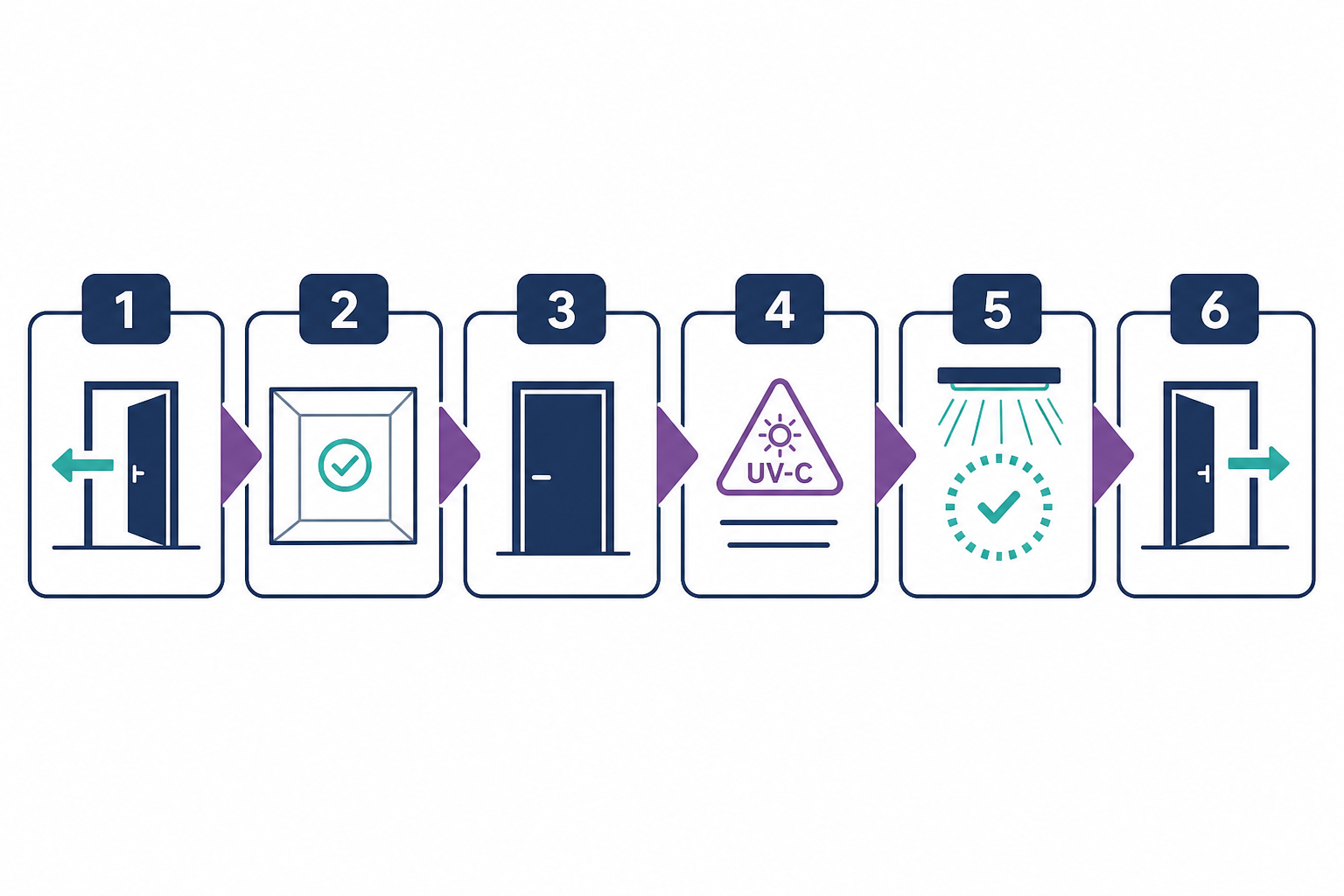
What safe deployment looks like in practice:
- Vacate — patients, visitors, and staff leave the enclosed room.
- Verify empty — visual check; no one behind doors, toilets, or equipment.
- Close the door — solid walls and closed door define the treated volume.
- Signage — “UV-C cycle in progress†visible before anyone approaches.
- Interlocks / motion-abort — door or motion sensors stop the cycle if the enclosure is breached.
- Cycle, then re-enter — only after completion and a clear all-clear.
That sequence is the doctrine made operational. Soften any step and you have reintroduced occupied-room risk.
Honest Caveat: Distance Inside the Room Is Not a Protocol
The honest caveat
A vendor whose deployment story requires people “keeping their distance†inside the treated space is describing an unsafe protocol. Curtains, hallway spectators, and occupied open bays are not workarounds—they are red flags. Safe UV-C is boring: empty room, closed door, signage, interlocks, then cycle. The same exclusion doctrine applies when high-dependency care moves into residences—see UV-C disinfection home healthcare.
Key Takeaways
- 254nm can cause photokeratitis and skin erythema; effects are dose-dependent and preventable with exclusion.
- UV-C never runs in occupied spaces—the safe unit is an enclosed room with a closed door.
- Curtains are not barriers; reflection and edge gaps defeat “stand back†rules.
- Open-plan halls are one optical space—vacate the whole volume or do not run room UV-C.
- Safe deployment: vacate → verify → close → sign → interlock/cycle → re-enter; align with IEC 62471 and ISO 15858 thinking.
Frequently Asked Questions
Can staff watch a UV-C cycle from the doorway?
No. An open door breaks the enclosed volume. Close the door, use signage and interlocks, and stay outside the treated space until the cycle completes.
Do goggles make occupied-room UV-C acceptable?
No. PPE does not redefine an unsafe optical space. Exclusion is the primary control; eyewear is not a licence to share the room with an active emitter.
Is a privacy curtain enough separation?
No. Fabric transmits and scatters UV, edges leak, and reflections bypass the curtain. Treat curtained bays as open optical space.
What standards should safety officers ask about?
Ask how the programme aligns with photobiological safety thinking under IEC 62471 and UV-C device safety practices such as ISO 15858:2016—plus how door interlocks and motion-abort are implemented on site.
Where does SpotlessAI fit?
Spotbot systems by SpotlessAI are designed for vacated enclosed rooms after manual cleaning, with cycle controls and safety expectations built around exclusion—not occupied-bay operation. Talk to our team if you want to review how that doctrine maps to your floor plans.
Conclusion
UV-C safety occupied room policy is not a branding detail. It is the difference between a controlled adjunct and a photobiology incident waiting to happen. Eyes and skin injuries are preventable when exclusion is non-negotiable.
Teach the doctrine once: enclosed room, empty, closed door, signed, interlocked, then cycle. Reject any story that keeps people inside the treated volume “at a safe distance.â€
If your safety committee wants a calm walkthrough of enclosed-room deployment—without occupied-bay shortcuts—the SpotlessAI team is ready when you are.