
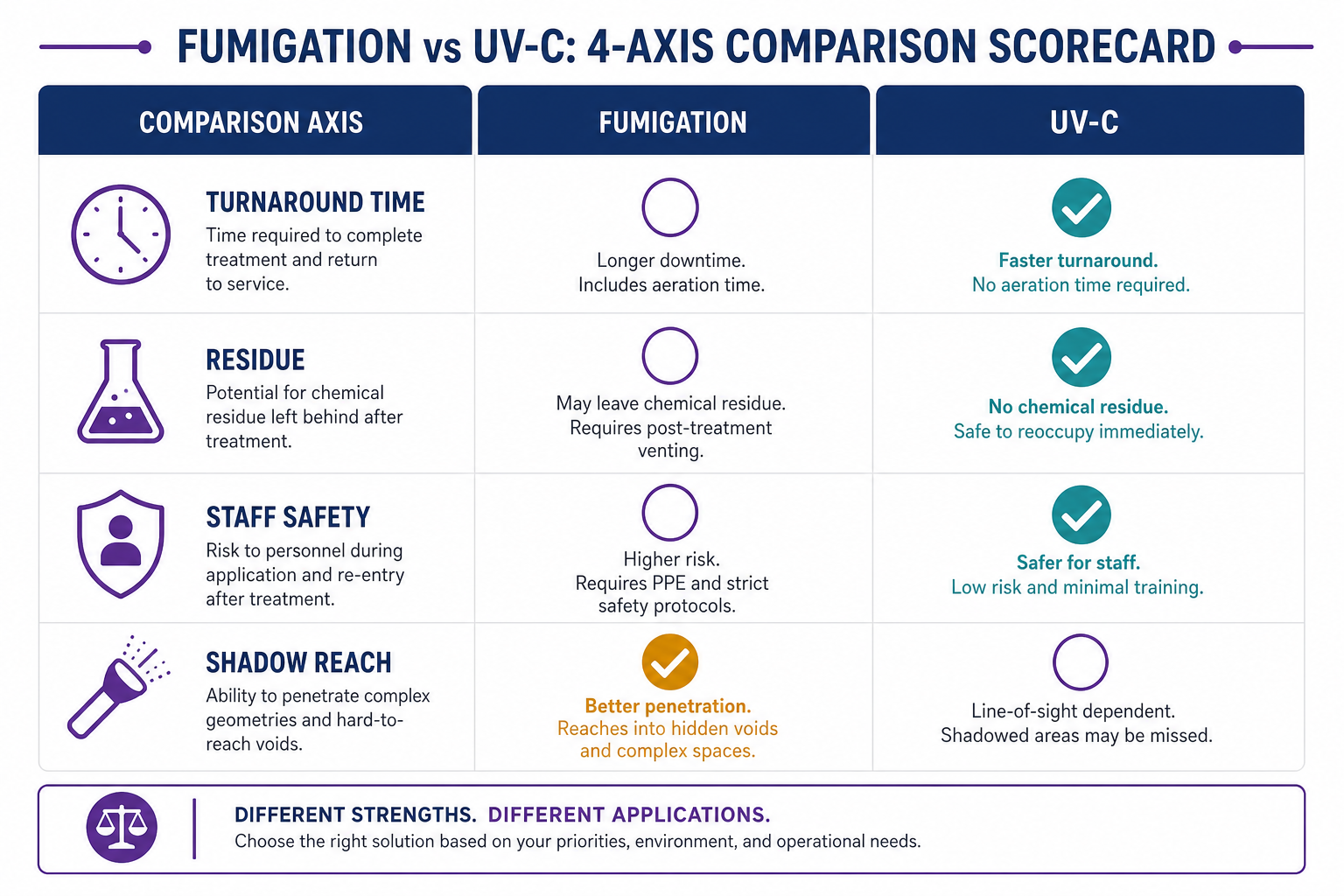
Fumigation vs UV-C operating theatre debates often start with loyalty to whichever method a facility grew up with. That is the wrong opening. OT managers, medical administrators, and anaesthesia leads need a comparison on the axes that actually lock or free a theatre: turnaround time, residue, staff safety, and shadow reach.
This article keeps the comparison fair. UV-C lands ahead on downtime and occupational exposure when used as a post-clean adjunct in an empty, enclosed room. Fumigation—especially vapour and fogging systems—still wins where gas can diffuse into geometry that light cannot see. Pretending otherwise is sales copy, not infection prevention.
For how no-touch steps fit broader room readiness, see hospital room turnaround. For UV optics limits, see UV-C shadowed surfaces.
Where Fumigation Came From in Indian OTs
Formaldehyde fumigation has a long operational history in Indian operating theatres. Generations of OT teams learned a familiar sequence: seal the room, generate vapour, wait through contact time, aerate, and only then reopen for the next list. The method felt thorough because the smell lingered and the downtime was obvious—visible sacrifice for a “sterile†feeling.
Newer hydrogen peroxide (Hâ‚‚Oâ‚‚) vapour and fogging systems changed the chemistry without always changing the operational mindset. Contact times shortened relative to classic formalin cycles in many programmes, and material-compatibility profiles differed, but theatres still face sealed-room logistics, aeration or re-entry rules, and chemical handling discipline.
Neither history nor novelty is an argument by itself. The right question is what each method costs in theatre hours, residual risk, and staff exposure—after manual cleaning has already removed soil.
Fumigation vs UV-C Operating Theatre Axis 1: Turnaround Time
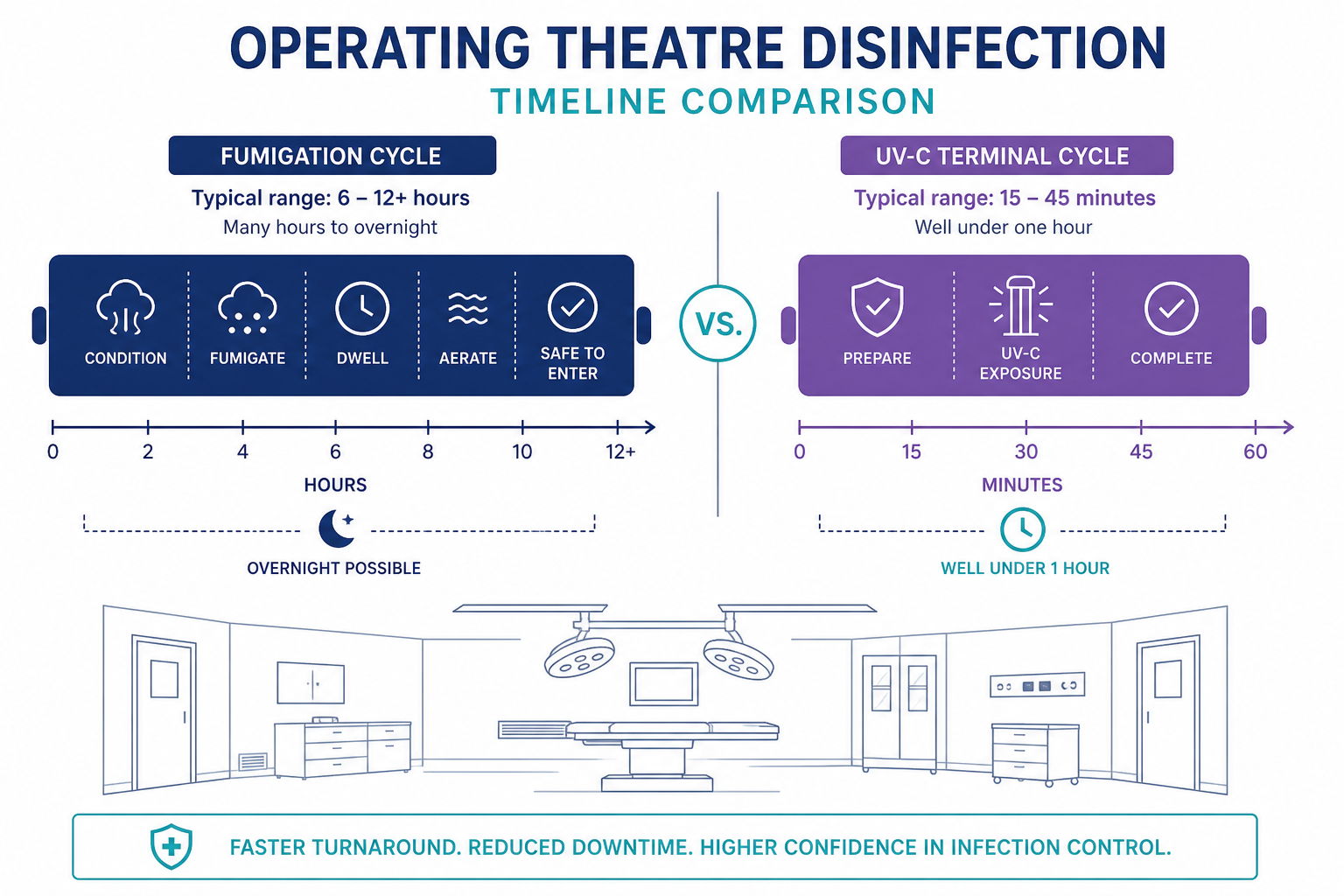
On turnaround, the gap is structural. Formaldehyde-style fumigation contact plus aeration commonly stretches across many hours and can lock a theatre overnight. H₂O₂ vapour programmes vary by product and room volume, but still typically consume far more clock time than a UV-C terminal cycle measured in well under an hour per positioning—once the room is vacated and cleaned.
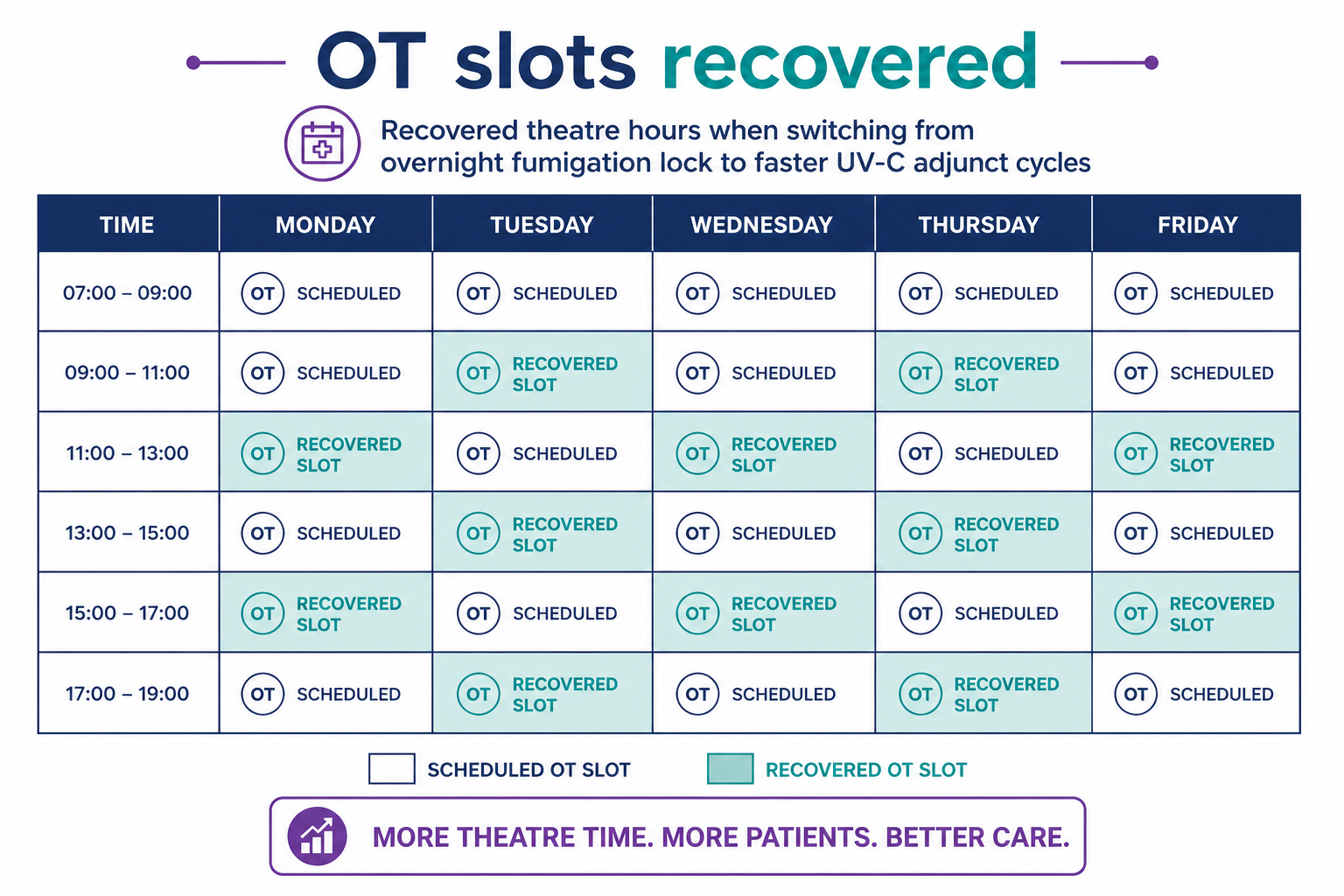
Frame the difference in theatre hours recovered, not in brochure minutes. An OT that reopens the same evening instead of the next morning recovers list capacity, reduces overtime cascades, and lowers the temptation to shorten cleaning when pressure rises.
UV-C does not erase preparation. Manual cleaning still comes first; multi-position cycles and room prep still take time. Even so, the downtime envelope is usually a fraction of classic fumigation lock-outs. Treat published cycle times as typical ranges—room size, clutter, and dose targets move the needle.
Weekly scheduling makes the operational case tangible. Hours not spent waiting for aeration become slots that anaesthesia and surgery teams can actually use—or buffers that protect the list when a case overruns.
Axis 2: Residue and Material Impact
Formaldehyde leaves a residue and off-gassing story that occupational-health frameworks take seriously. International occupational-health frameworks take formaldehyde seriously—for example, the U.S. OSHA formaldehyde standard sets exposure limits and handling expectations because vapour is not a casual indoor chemical; WHO and IARC-aligned classifications likewise treat formaldehyde as a carcinogen of concern. Corrosion and material staining concerns also appear in facilities that fumigate frequently.
UV-C leaves no chemical residue on surfaces. That is a genuine advantage for rapid re-entry after a validated empty-room cycle. Honesty cuts both ways: heavy, repeated UV-C exposure can age polymers, tubing, and some plastics over long horizons. Materials compatibility and lamp-placement discipline belong in the evaluation—not only “no smell means safe.â€
Hâ‚‚Oâ‚‚ systems reduce some formalin-era residue problems but still introduce oxidising chemistry, aeration rules, and compatibility checks. Residue is not a single score; it is chemistry plus materials plus how often the OT repeats the process.
Axis 3: Staff Safety and Protocol Burden
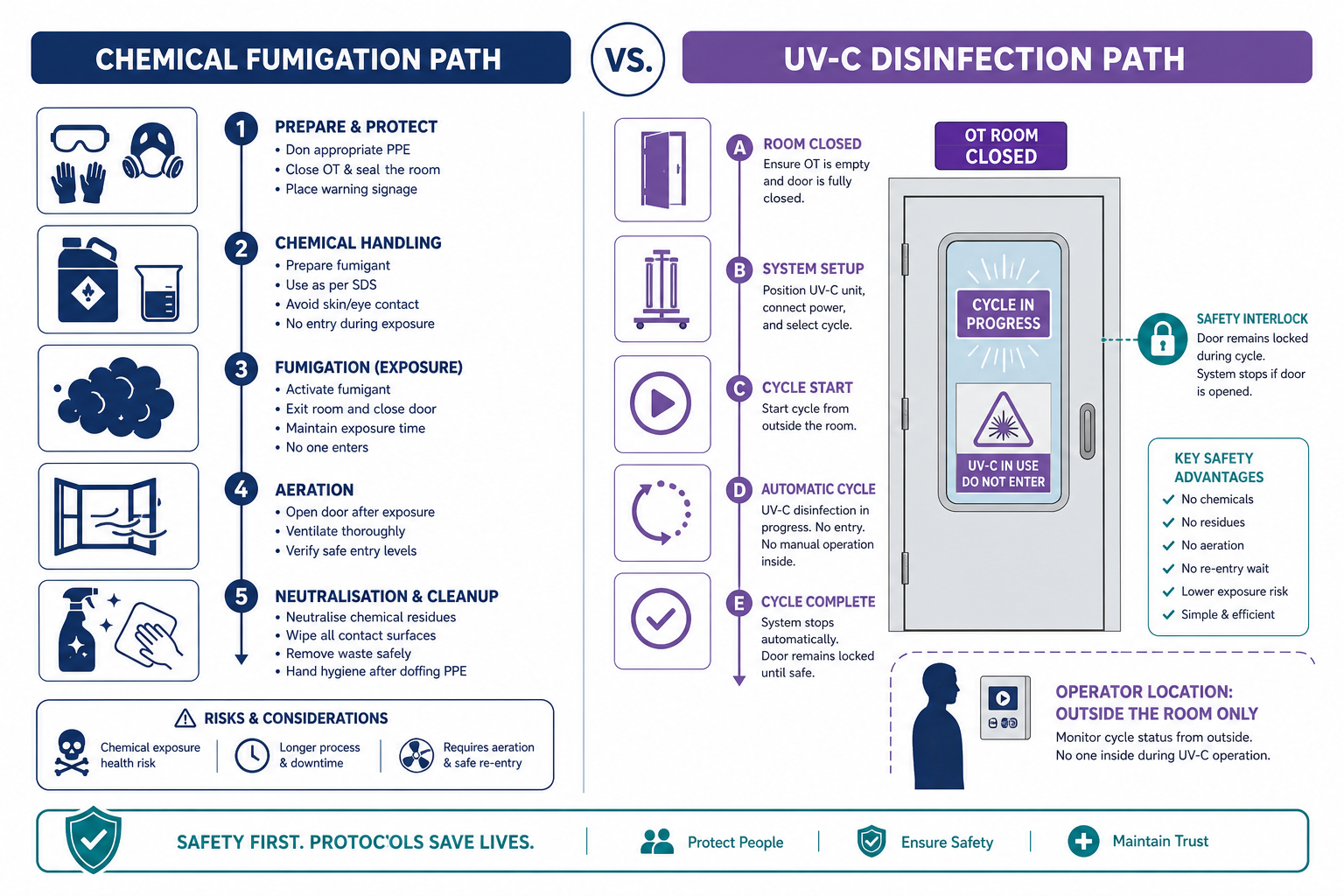
Chemical fumigation asks staff to handle hazardous agents, wear appropriate PPE, manage spills, and complete neutralisation or aeration before re-entry. The burden is real even when teams are experienced. Errors in sealing, dosing, or premature entry create acute exposure risk.
UV-C’s non-negotiable safety unit is an empty, enclosed room—solid walls, closed door, interlocks and signage, operator outside. A curtain is not a barrier. That protocol is strict, but it removes chemical exposure and neutralisation steps from the daily OT hygiene path.
Both methods need protocol. One needs PPE and chemical controls; the other needs occupancy control and optical safety. Choosing UV-C is not choosing “no rulesâ€â€”it is choosing a different, often lighter, occupational-risk profile when discipline holds.
Axis 4: Efficacy Profile—The Fair-Balance Paragraph
Say it plainly: fumigant vapours reach shadows that light cannot. Undersides, crevices, and cluttered geometry remain UV-C’s structural weakness. Multi-position cycles and manual follow-up mitigate that gap; they do not abolish line-of-sight physics. Our deep dive on UV-C shadowed surfaces exists for that reason.
UV-C’s counter-case is speed, dose repeatability, and documentation—after manual cleaning removes soil. In one SpotlessAI field evaluation as a post-manual-clean adjunct at a 300-bed hospital, swab sampling across 1,000+ points supported 99.99% bacterial elimination under those conditioned programme conditions. That figure does not claim UV-C beats vapour inside every shadowed niche, and it does not license skipping wipe cleaning.
For the wider “what UV can and cannot do†framing, see UV-C disinfection limitations.
OT Fumigation Alternative India: What Changes When You Compare Protocols
Regulatory and expert direction in several countries has moved away from routine formaldehyde fumigation in healthcare settings because of occupational and environmental concerns. Indian hospital leadership increasingly hears the same caution from infection-control and occupational-health voices: treat routine formalin OT fumigation as a legacy practice under review, not as an automatic gold standard.
An OT fumigation alternative India conversation should not start with “UV replaces gas.†It should start with clean → choose the adjunct that matches risk and capacity → verify. Where theatres still need vapour for specific high-risk scenarios, say so. Where daily list pressure makes overnight lock-outs unsustainable, UV-C after manual clean is often the more operable layer—provided shadows are managed honestly.
Honest Caveat: Vapour Wins Shadows; UV-C Wins the Operable Day
The honest caveat
Vapour still reaches where light does not. The case for UV-C in operating theatres rests on turnaround speed, repeatability, documentation, and staff safety—not on beating fumigation at shadow coverage. UV-C remains an adjunct to manual cleaning in an empty enclosed room; shadowed surfaces need prep, multi-position thinking, and flagged follow-up.
Key Takeaways
- Compare fumigation and UV-C on turnaround, residue, staff safety, and shadow reach—not on nostalgia.
- Classic fumigation often locks theatres for many hours or overnight; UV-C cycles are typically far shorter after cleaning.
- Formaldehyde carries residue and carcinogen-class exposure concerns; UV-C leaves no chemical residue but can age polymers with heavy use.
- Both need protocol: chemicals need PPE and aeration; UV-C needs an empty interlocked room.
- Fumigation wins shadow reach; UV-C’s case is speed, repeatability, documentation, and occupational safety.
Frequently Asked Questions
Does UV-C replace OT fumigation completely?
Not as a universal claim. Many theatres can move routine terminal steps to a clean-then-UV-C path and recover hours. Specific high-risk scenarios may still justify vapour—decide with IPC, not with marketing.
Is Hâ‚‚Oâ‚‚ fogging the same as formalin fumigation?
No. Chemistry, contact times, and material profiles differ. Both still impose sealed-room and re-entry discipline that UV-C does not share in the same way.
Can UV-C run between cases with people nearby?
No. UV-C requires an empty enclosed room. Curtains are not barriers. Operator and team stay outside during the cycle.
Does UV-C clean blood and soil in the OT?
No. Manual cleaning removes organic soil. UV-C is an adjunct disinfection step after cleaning—never a substitute for wipe protocols.
Where does SpotlessAI fit?
Spotbot systems by SpotlessAI are positioned as post-manual-clean UV-C adjuncts for vacated enclosed spaces, with safety interlocks and cycle records—not as chemical fumigation replacements that ignore shadows. Talk to our team if you want to map theatre turnaround options for your facility.
Conclusion
Fumigation vs UV-C operating theatre choices should be scored like operations problems: hours locked, residue left behind, staff exposed, and shadows missed. On downtime and occupational safety, UV-C after manual cleaning usually wins. On shadow reach, vapour still has the physics advantage.
Build the programme that recovers theatre hours without pretending light fills every crevice. Clean first. Choose the adjunct with eyes open. Verify what you claim.
If your OT leadership wants a calm comparison workshop—without silver-bullet promises—the SpotlessAI team is ready when you are.