
Robotics as a service hospital leaders should judge on outcomes, not catalogue stickers. Most facilities do not need to own a disinfection robot; they need reliable vacated-room cycles after manual cleaning, with uptime, lamps, and reporting handled as a service. Renting (RaaS) usually fits that reality better than a one-time capital buy—though buying can win for a clear minority of programmes.
This post explains the model calmly: what a subscription typically bundles, how cash-flow and risk shift, when purchase is genuinely better, and the hybrid path many committees use to de-risk. For how UV-C robots fit clinical workflows, see intelligent UVC disinfection in modern hospitals. For turnaround pressure that drives utilisation maths, see hospital room turnaround. For method choice in theatres, see fumigation vs UV-C operating theatre.
Robotics as a Service Hospital Reality: Capex Is the Wrong Frame
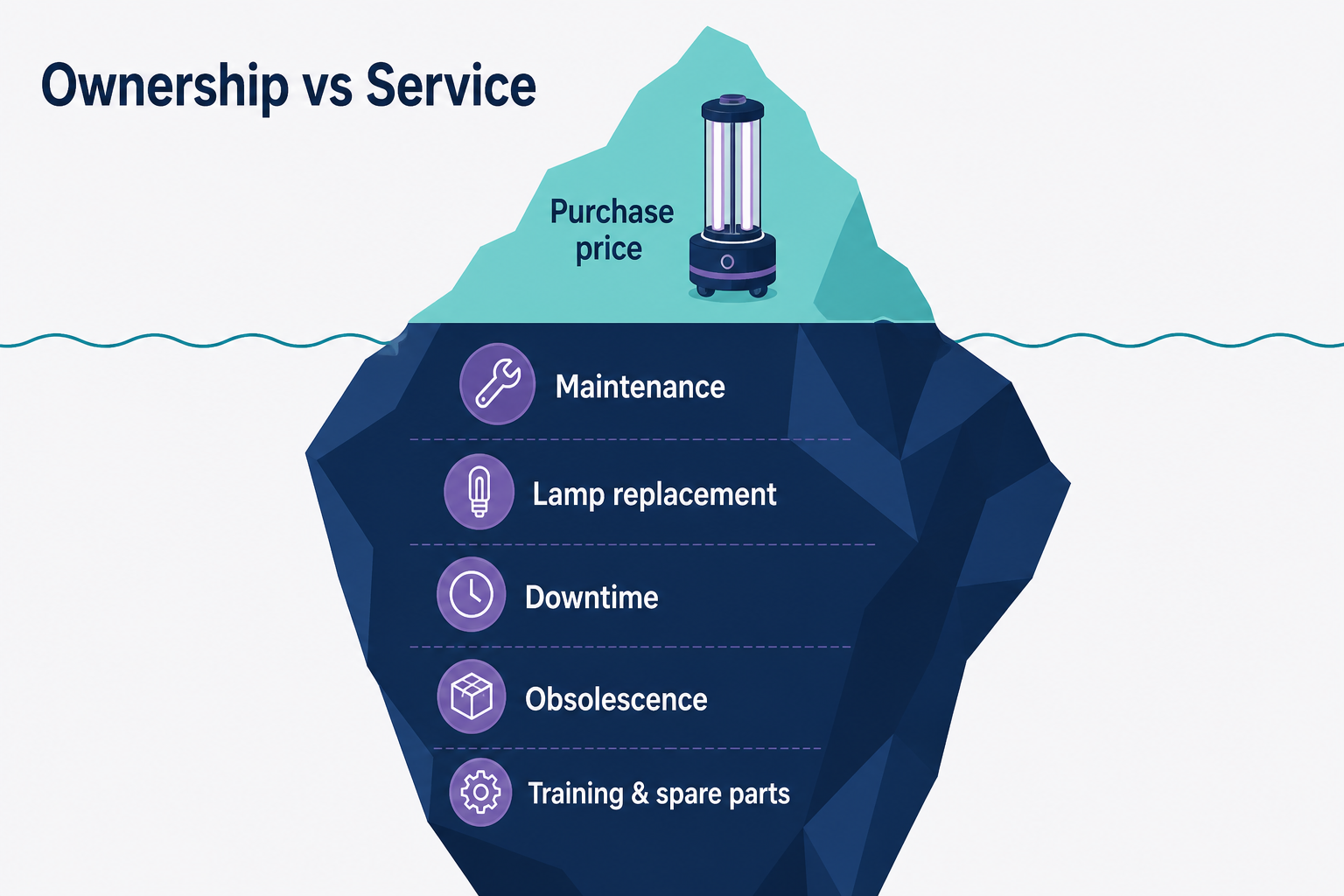
Hospitals buy disinfected rooms and governed processes—not machines for their own sake. The robot is the means. Framing the decision as “asset versus no asset” hides the real cost stack: preventive maintenance, lamp decay, downtime cover, operator training, software, and eventual obsolescence.
That is the ownership iceberg. The purchase line is visible; the service obligations sit below the waterline. A robotics-as-a-service conversation starts with the outcome you need each month and asks which structure delivers it with least operational surprise.
UV-C remains an adjunct to manual cleaning in unoccupied rooms—never a substitute for soil removal. Procurement should fund a programme, not a trophy device.
What a Subscription Typically Bundles
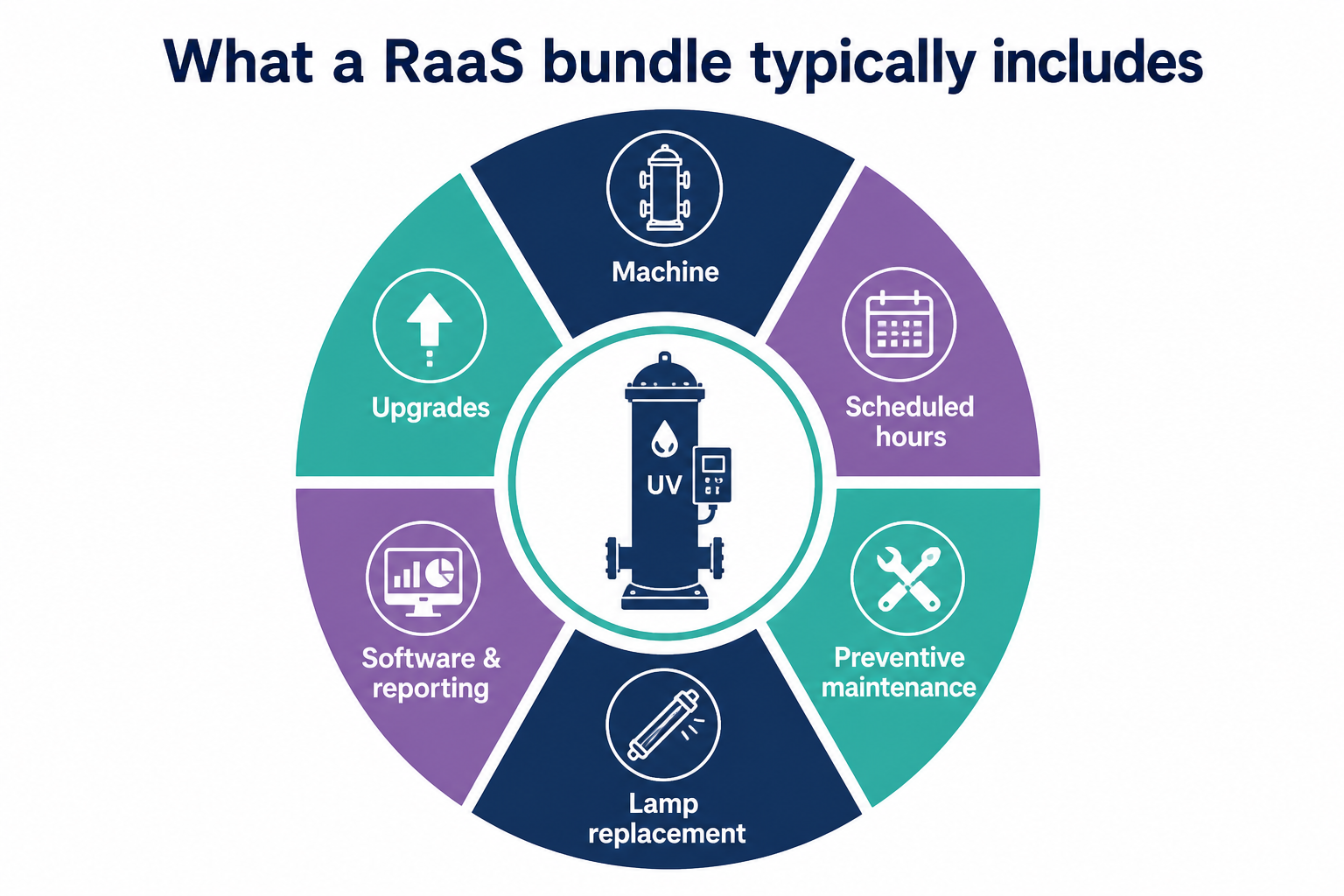
A mature RaaS agreement usually packages more than hardware access:
- The machine — deployment-ready unit under vendor care
- Scheduled operation hours — capacity aligned to your turnover pattern (defined in the contract; not a free-form hour buffet)
- Preventive maintenance — planned visits instead of scramble repairs
- Lamp replacement — consumables with real decay curves, not “run until fail”. For why glow is not a dose meter, see UV-C lamp lifespan degradation.
- Software and reporting — cycle evidence that quality can file; see also digital disinfection records
- Upgrades — path to newer firmware or hardware without a second capital case
Ownership still pays for each of those lines—often later, under different budget owners, when failures interrupt beds. Bundling does not magically remove cost; it makes the cost shape visible and attributable to the service outcome.
Cash-Flow and Risk Logic
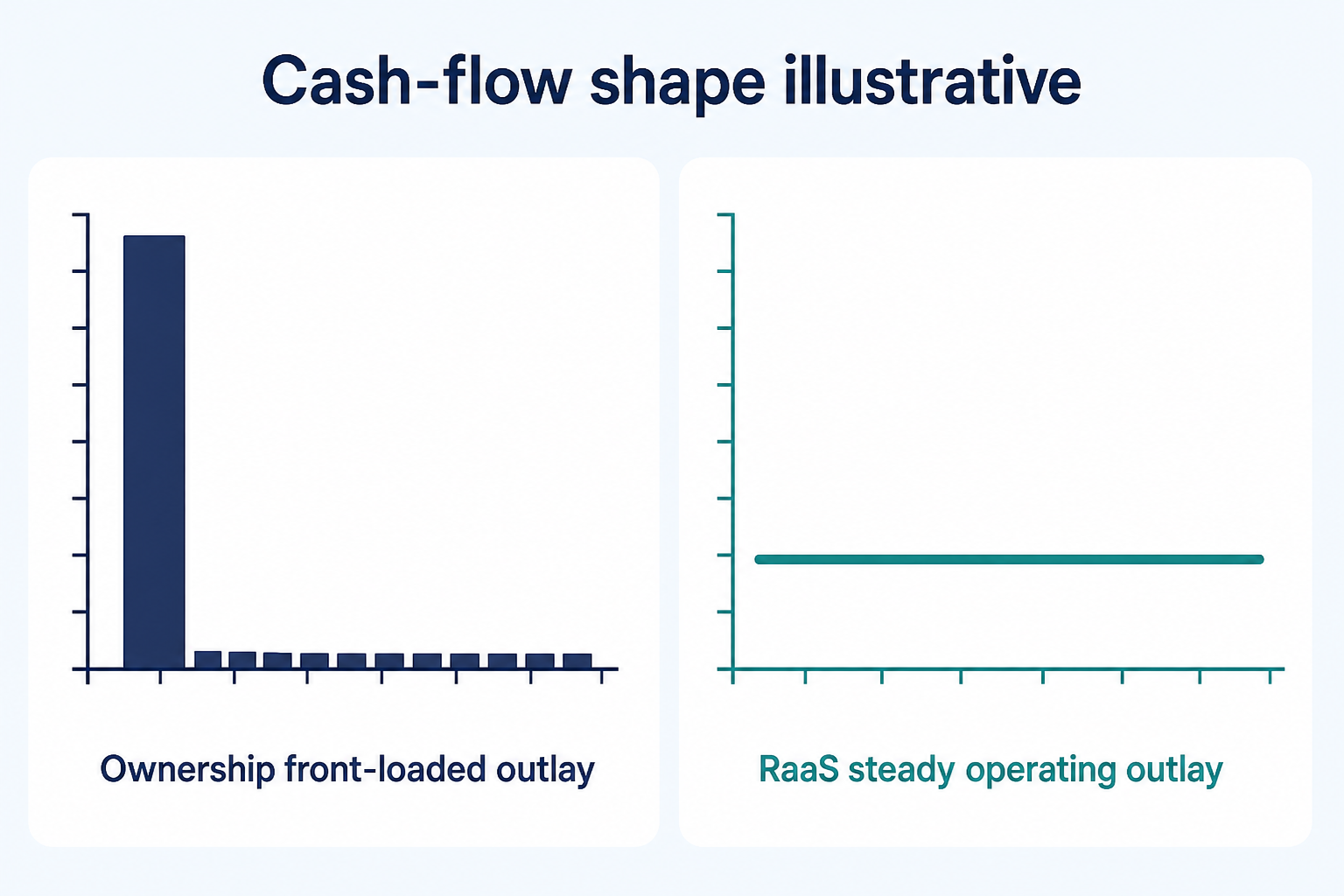
Ownership concentrates outlay at the start, then dribbles surprise costs across years. RaaS converts that into operating expenditure from month one: a flatter shape that finance teams can forecast against census and turnover.
Risk shifts with the cash shape. Under a well-written service agreement, the vendor carries more hardware-failure and consumable risk; the hospital pays for availability. That alignment matters: a RaaS vendor must keep earning the fee by keeping the programme useful. Exit clauses—when drafted honestly—are part of that discipline, not a loophole.
Illustrative charts help committees see shape, not sticker shock. Run the comparison with your own utilisation assumptions; do not accept someone else’s “break-even story” without your bed and shift data.
Disinfection Robot Rental vs Purchase: When Buying Genuinely Wins
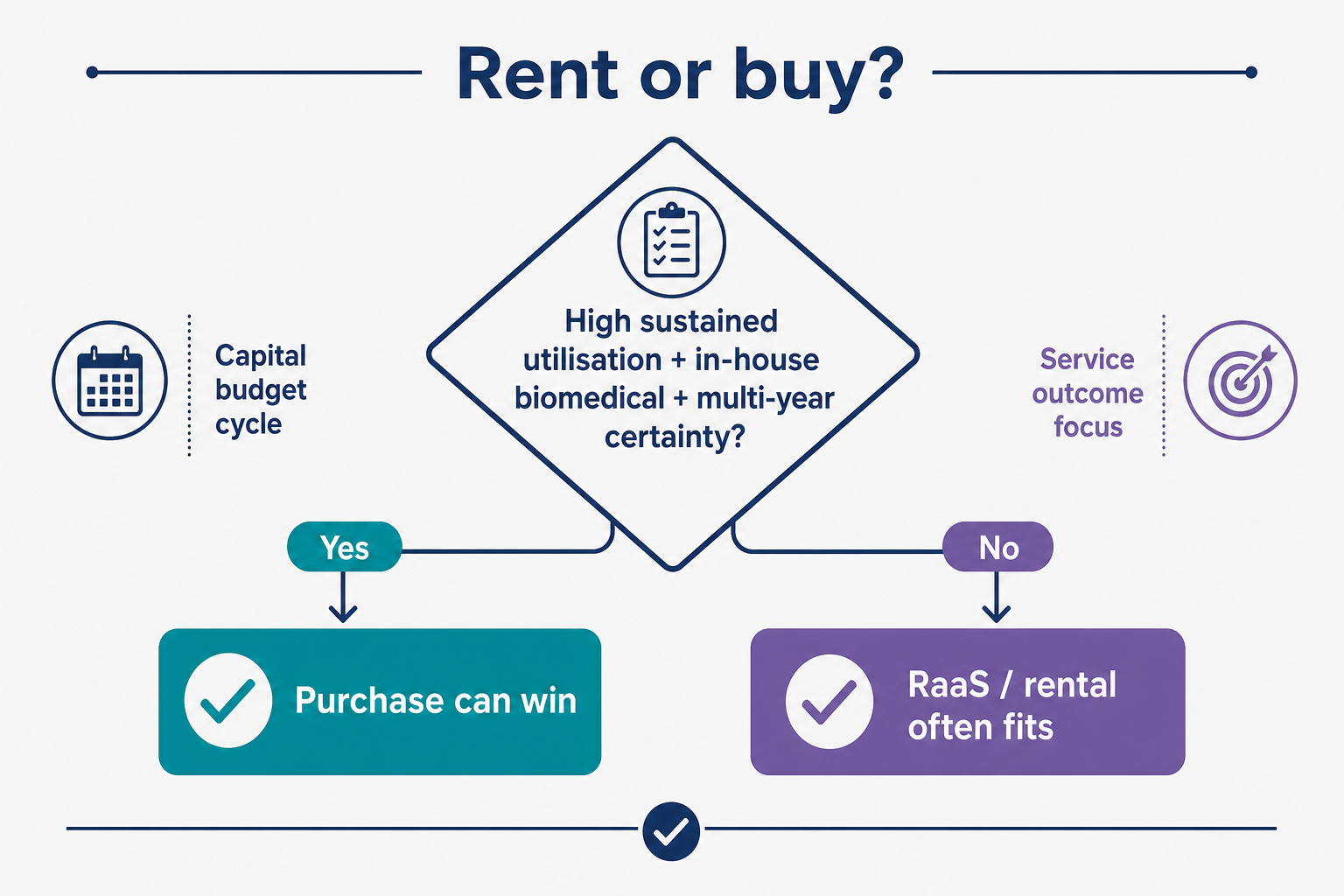
Purchase is not a failure mode. It can be the better structure when several conditions stack:
- Very high sustained utilisation — the unit is rarely idle across the planning horizon
- Capital budget cycles that favour assets — opex is constrained while approved capex is available
- In-house biomedical capability — skilled staff, spare-part logistics, and lamp planning already exist
- Multi-year programme certainty — leadership, SOPs, and ward coverage are stable enough to own the lifecycle
If those are weak—pilot phase, uneven night utilisation, thin biomedical cover—disinfection robot rental vs purchase usually tilts toward rental/RaaS. Fair committees score both columns; they do not invent straw-man ownership costs to force a preferred answer.
The Hybrid Path: Subscribe First, Convert Later
Many vendors offer subscription-to-purchase conversion: early service payments credited toward a later buy once utilisation and SOPs prove themselves. That is industry practice for de-risking—not a secret discount ladder to advertise here.
Ownership-mode programmes often add annual maintenance contracts that recreate parts of the RaaS bundle—PM, parts, sometimes lamps—without the same exit flexibility. Compare like with like: a naked purchase plus thin AMC is not the same product as a full service ring.
Operational evaluation frameworks for environmental cleaning programmes—such as those summarised by public-health agencies including the CDC—still matter under either commercial model. The contract structure does not replace cleaning validation discipline.
Honest Caveat: Not Universally Cheaper Over Five Years
The honest caveat
RaaS is not universally cheaper over a five-year horizon. It is usually more predictable and lower-risk for facilities still proving utilisation. High, stable use with strong in-house biomedical support can make ownership the better economics. Run your own utilisation numbers—rooms per day, idle time, lamp cycles, cover staff—before you treat any model as destiny. For theatre downtime maths CFOs can run with their own ledger, see operating theatre cost per hour India.
Key Takeaways
- Buy the service outcome (governed vacated-room cycles after manual cleaning), not a machine as an end in itself.
- A useful RaaS bundle covers machine, hours capacity, PM, lamps, reporting, and upgrades—not hardware alone.
- Cash-flow shape and who carries failure risk matter as much as headline commercial labels.
- Purchase can win with high sustained utilisation, capital-favouring budgets, biomedical depth, and multi-year certainty.
- Hybrid subscribe-then-convert paths de-risk decisions; RaaS is not always cheapest over five years.
Frequently Asked Questions
Is RaaS just leasing with marketing language?
Not if the agreement truly bundles maintenance, consumables, reporting, and service levels. A bare hardware lease without those elements is closer to financed ownership than robotics-as-a-service.
Will renting lock us into one vendor forever?
Contract length and exit terms vary. Ask for clear notice periods, data export for cycle records, and what happens to lamps and spare inventory on exit—before you sign.
Does buying mean we skip maintenance spend?
No. Ownership still needs preventive maintenance, lamps, downtime cover, and eventual refresh. Those lines often appear later under different cost centres.
How should a purchase committee compare offers?
Score outcome SLAs, exception reporting, training, spare cover, and exit rights alongside commercial structure. Avoid deciding on sticker labels alone.
Where does SpotlessAI fit?
SpotlessAI supports hospital programmes with Spotbot platforms and service conversations aimed at reliable adjunct UV-C cycles after manual cleaning. Talk to our team about which commercial path fits your utilisation—not a one-size pitch.
Conclusion
For most facilities still proving coverage and biomedical depth, robotics as a service hospital programmes reduce surprise and keep the vendor aligned with uptime. For a minority with high, stable utilisation and strong in-house capability, purchase remains a rational choice.
Judge the iceberg, the bundle ring, and your utilisation—not a brochure slogan. Hybrid paths exist when you want proof before ownership.
If your committee wants a calm walkthrough of model mechanics against your turnover pattern, the SpotlessAI team is ready when you are.